The Reason AI Makes the Open Web More Necessary — and Easier to Build On
AI is flooding mainstream platforms with synthetic content while simultaneously making self-hosted, creator-owned infrastructure easier to run than ever. That's not a coincidence. It's an opportunity.

The same technology making mainstream platforms harder to succeed on is also making it easier than ever to build your own.
That's the AI paradox for creators. Understanding it changes how you think about where to put your time and infrastructure.
What AI is actually doing to platform reach
AI-generated content is growing faster than platforms can reliably filter it. Synthetic text, images, video, and audio are flooding feeds that once depended on human effort to stay fresh.
This creates two problems that compound each other.
The first is signal dilution. When the cost of producing content drops to near zero, the quantity of content explodes — and the average quality of what's competing for attention drops with it. Your well-researched post is fighting for the same real estate as ten thousand algorithmically optimized variations on the same topic, most of which were never read by a human before they were published.
The second problem is subtler, and more corrosive. Many major platforms are now building AI systems around creator content in ways that blur the line between distribution, recombination, and competition. You did the creative labor. They captured the value. You're not a partner in that arrangement. You're the training data.
This is a different kind of lock-in than the one we covered in Post #1. It's not just that your audience is trapped on their platform. It's that your creative output is being absorbed into infrastructure you'll never own or benefit from.
The authenticity premium
When synthetic content becomes the ambient noise of the internet, something previously undervalued becomes scarce: verifiable human voice. A real person, writing from genuine experience, with a public identity and a body of work that can be traced and followed over time.
AI can mimic the form of authenticity. It can't reproduce the relationship behind it.
A recent Guardian piece captured what this looks like on the ground — artists across disciplines, from Stewart Lee to Werner Herzog, being pushed to produce short-form video content or risk irrelevance. One musician calculated he spent four hours a day in 2025 creating social content. "In that time," he wrote, "I barely picked up an instrument." The algorithm doesn't just dilute your feed. It redirects the creative labour that used to produce the thing worth following.
Take Andy Matuschak as one example. He's an independent researcher who publishes almost everything at andymatuschak.org and notes.andymatuschak.org. These sites aren't just blogs — they're his public thinking environment, a durable archive of essays, experiments, and working notes on learning systems and personal knowledge management.
Matuschak uses social platforms like Mastodon (@andymatuschak@hachyderm.io) and X for conversation and distribution. But his sites are the center of gravity. Readers who want his real work go there. The relationship persists.
Owned media and federated publishing — the stuff we've been building toward in this series — are actually structurally better positioned for this shift than mainstream platforms. A Ghost publication that federates through ActivityPub gives readers a direct, followable identity outside the platform where they first found you. That's why this publication is built on Ghost and federates through ActivityPub: it's infrastructure for durable audience ownership, not just a blog or newsletter. A reader who follows @index@federatedmind.com from their Mastodon account has made a deliberate choice to receive your work directly, outside of any algorithmic feed. That relationship is qualitatively different from a follow on a platform optimizing for session time.
The fediverse, as we explained in Post #2, was designed around exactly this kind of portable, durable identity. That design choice looks more valuable now than it did five years ago.
The part where AI actually helps you
The same AI tools that are degrading the signal-to-noise ratio on mainstream platforms are also dramatically lowering the operational cost of running your own infrastructure.
Self-hosting used to require a specific kind of person: someone who could configure a Linux server, read documentation that assumed fluency in networking concepts, troubleshoot federation issues at the protocol level, and spend a weekend getting Mastodon to talk to the rest of the fediverse correctly. That's a real barrier. It's why self-hosting has historically been a hobbyist activity rather than a realistic option for individual creators.
AI assistants have changed that calculus. They can now walk you through a Mastodon instance setup on a DigitalOcean droplet in a single conversation. They can help you configure your federation rules, set up your SMTP relay, troubleshoot attachment issues, and explain what each configuration option actually does. They can help you write moderation policies and handle the ongoing administration work that used to require either deep technical knowledge or a dedicated sysadmin.
The same is true for PeerTube. For self-hosting Ghost. For running your own email list infrastructure.
The operational cost of the open web stack — not just the setup, but the ongoing management — is declining in real time. What required specialized technical skill in 2020 now mostly requires patience and a good AI assistant. That is a material change in who can realistically build this kind of stack.
Both forces point in the same direction
Mainstream platforms are getting harder to stand out on while also extracting more value from creator output. Meanwhile, the infrastructure to build outside those platforms is becoming more accessible than it's ever been.
These two forces aren't in tension. They're both pointing the same direction: owned media, federated identity, creator-controlled infrastructure.
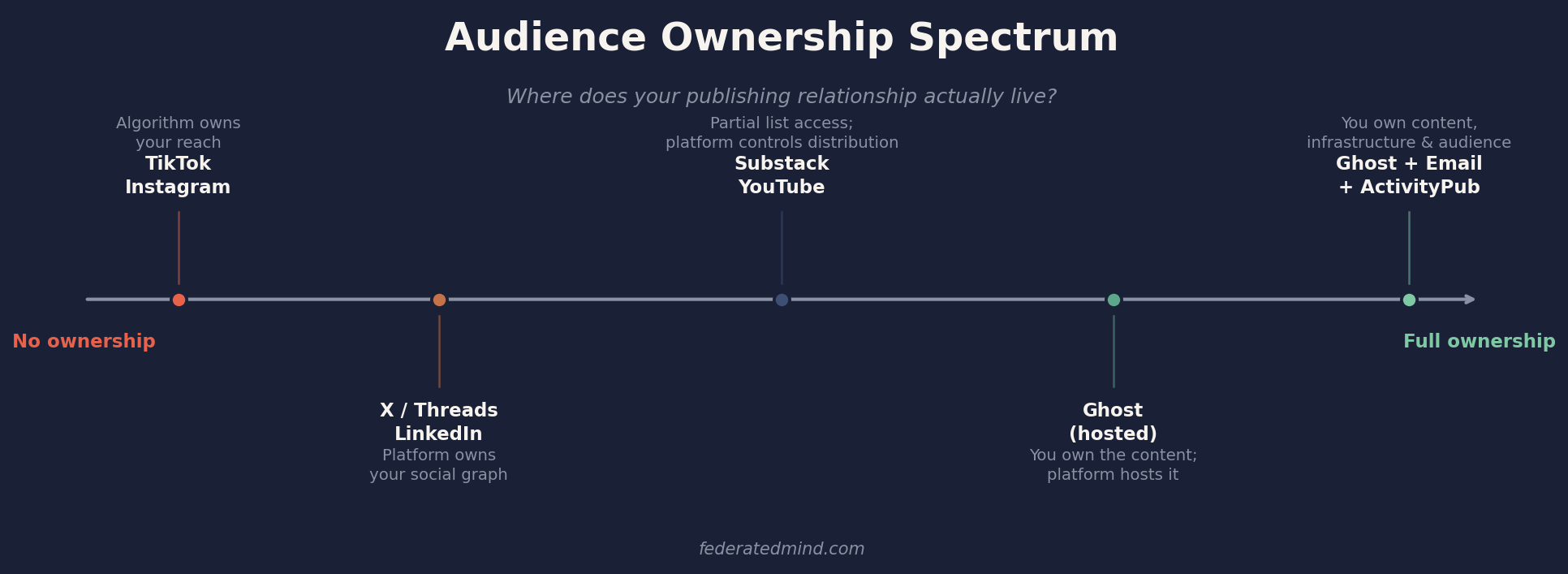
The fediverse isn't a reaction to AI. But it turns out to be a remarkably good answer to the problems AI is creating for creators on mainstream platforms. Public, portable identity is harder to quietly absorb, repackage, and redirect inside a single closed platform. Owned infrastructure means your content's value stays with you. Portability means you're not dependent on any single platform's decision about how to treat its creators. And AI systems themselves tend to reward content that is well-structured, clearly authored, and easy to parse — which gives owned publishing another practical advantage. The same tools that flood feeds also make structured, well-authored open content easier for readers and machines to find.
The argument for building on open infrastructure was always philosophical. Now it's also strategic.
What this means practically
None of this means abandoning mainstream platforms tomorrow. They still have reach that the open web can't match today, and that's worth being honest about.
What it means is that the calculus is shifting. Every piece of content you publish through owned infrastructure, every subscriber who joins your list directly, every follower who connects to your federated account rather than your platform profile — those are relationships that no platform can degrade, no algorithm can suppress, and no platform shift can erase.
If you want to start somewhere practical, the Fediverse Quick-Start Checklist we put together walks through the first steps — free, takes about 20 minutes.
The open web isn't the alternative to AI-era platforms. It's the infrastructure built to outlast them.
Sources and further reading
- World Wide Web Consortium (W3C). ActivityPub Protocol Specification. W3C Recommendation, 23 January 2018.
- Ghost Foundation. Joining the ActivityPub Network. Ghost Changelog, 2024.
- Meta Platforms. "Threads Has Entered the Fediverse." Meta Engineering Blog, 2024.
- Doctorow, Cory. "Enshittification: How Platforms Die." Pluralistic, January 2023.
- Mastodon gGmbH. Mastodon Server Administration Guide. Mastodon Documentation, 2024.
- Wray, Daniel Dylan. "'This craving to go viral is tiresome': the artists sick of the pressure to promote on social media." The Guardian, 15 April 2026.
Get posts on AI tools and the open web, direct to your inbox. Free.