Forums, Reading, and Music on the Fediverse
Lemmy, kbin, and PieFed rebuild Reddit as a federation of communities. NodeBB and Discourse bring old-school forums onto the same protocol. BookWyrm tracks reading without selling data, and Funkwhale and Bandwagon do the same for music. Different formats, one open protocol.

Part 4 of The Fediverse Beyond Mastodon, the closing post in the series. This one covers forums, discussion communities, and the more solitary formats built for reading and listening.
Part 1 covered the microblogging forks. Part 2 covered the visual fediverse. Part 3 covered the platforms built for words.
On April 18, 2023, Reddit announced it would begin charging for API access, a change widely seen as tied to its planned initial public offering. Reddit disclosed pricing to developers on May 31: an enterprise tier that put a real price on scale, $12,000 per 50 million requests according to third-party developers, effective July 1, 2023. Third-party clients had built their entire product around free API access, and Apollo, Reddit is Fun, Narwhal, and BaconReader all announced shutdown dates. On June 12, the blackout began, planned as a 48-hour protest. Over 8,000 subreddits went dark, with some announcing longer or indefinite closures.
Fediverse Observer reported Lemmy going from roughly 1,000 monthly active users in May 2023 to about 23,800 by mid-June, a roughly 25x increase in about two weeks, and later that year an all-time peak of roughly 72,600 MAU. Kbin, a smaller project at the time, went from about 300 users on June 12 to more than 30,000 within a week. Combined, Threadiverse accounts (Lemmy and kbin together) grew on the order of tens of thousands to well over 100,000 accounts in under two weeks.
It was the same pattern the fediverse had already lived through with Twitter: a centralized platform breaks its social contract with the people who built an ecosystem on top of it, and those people go looking for an alternative that can't do the same thing to them again. By mid-2023, that alternative already had an audience paying attention, because Twitter got there first. Elon Musk's acquisition closed in October 2022, and Twitter's own API paywall followed soon after. Mastodon and ActivityPub were already live topics in the tech press eight months before Reddit's blackout began.
The wave didn't land the same way for the Threadiverse that it had for Twitter: forums need density that microblogs don't. A Mastodon account with 50 followers can sustain a real conversation. A community built around a specific hobby needs thousands of members before anyone shows up to answer the question someone just asked. Most of 2023's wave receded. Lemmy's current MAU, around 43,000 per FediDB in June 2026, sits well below its 72,600 peak, and kbin itself stopped development entirely.
Where things stand
| Platform | FediDB (MAU) | FediIndex (active) | fediverse.observer (½-yr) |
|---|---|---|---|
| Lemmy | 423 servers / ~43K | 509 servers / ~32K | 501 servers / ~66K |
| NodeBB | 46 servers / ~10K | 55 servers / ~43K | 64 servers / ~307K |
| PieFed | 76 servers / ~4.8K | 87 servers / ~6K | 87 servers / ~14.5K |
| Bookwyrm | 70 servers / ~3.5K | 89 servers / ~1K | 86 servers / ~5.2K |
| Mbin | 20 servers / ~1.3K | 19 servers / ~0.8K | 20 servers / ~2.4K |
| Funkwhale | 38 servers / ~730 | 81 servers / ~240 | 82 servers / ~750 |
The Threadiverse
Part 1 introduced Lemmy, PieFed, and Mbin briefly. This post covers all three in depth.
Lemmy
Lemmy sits at the center of it: a link aggregator and discussion platform, open-source, self-hostable, running ActivityPub. Two developers known by their handles, Dessalines and Nutomic, started building it in February 2019, four years before the 2023 wave gave it an audience.
Dessalines and Nutomic work on Lemmy full-time, funded by donations through Liberapay, Open Collective, and Patreon rather than a company or a single grant, supplemented by funding from the NLnet Foundation, the same organization behind grants for kbin and a number of other fediverse projects this series has covered. Lemmy's own funding posts have been direct about how thin that runs: one update put total donations at 2,000€ a month, 1,000€ per developer, short of the 5,000€ they've said would be enough to pay both of them a sustainable salary. The backend runs on Rust, using the Actix framework and Diesel against a PostgreSQL database; the frontend is TypeScript and Inferno.
Instances
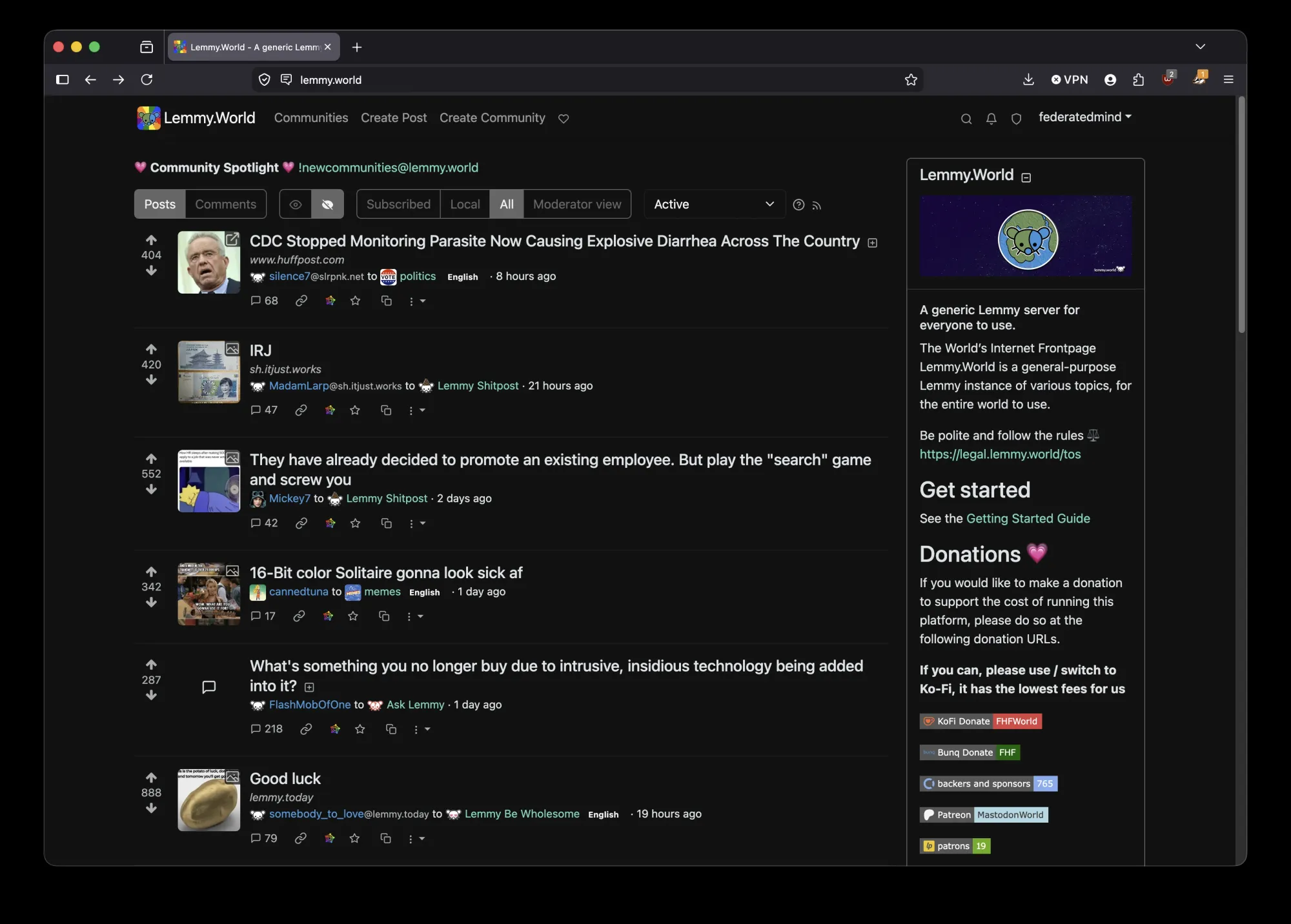
Lemmy.world is the largest, general-purpose, with permissive moderation. Lemmy.ml is the original instance, running a stricter, consistently left-leaning moderation culture. Beehaw.org built its identity around being explicitly community-focused, with a small, curated set of communities rather than lemmy.world's everything-goes breadth. Hundreds of smaller instances sit around these three, organized by hobby, region, or politics, with the full list browsable at join-lemmy.org/instances; traffic between them shifts constantly, tracking moderation reputation and whichever subreddit exodus most recently sent people looking.
Clients
Jerboa, built by Lemmy's own developers, is the official Android app. Mlem covers iOS natively. Voyager and Photon are mobile-first web clients built to feel like Apollo or other old-guard Reddit apps, and Alexandrite is a desktop-first alternative for browser use. Any of them works against any Lemmy instance: the same account-portability argument this series keeps coming back to.
Kbin/Mbin
Ernest Wisniewski started building kbin in January 2021, backed early on by grant funding from the NLnet Foundation, and it federated with the Threadiverse and Mastodon at the same time: a kbin "magazine" (kbin's term for a community) was subscribable from Lemmy, and separately, an ActivityPub actor that Mastodon users could follow directly. Mbin, forked in October 2023, is its actively maintained successor and still works exactly this way: subscribe to @community@fedia.io from a Mastodon account, and new link posts show up in the home feed; post a reply, and it lands in the thread as a comment. Neither side needs special setup, though cross-server delivery has a well-earned reputation for flakiness: posts and replies sometimes take hours to show up, and deep-thread replies are the part most likely to go missing entirely.
Kbin.social became one of the largest Threadiverse instances during the 2023 wave, then ran into the problem every single-maintainer project eventually hits: Wisniewski was the sole maintainer, running infrastructure for hundreds of thousands of users alone, and personal circumstances took him away from the project for long stretches. The instance eventually went down and stayed down. Community members forked the codebase into Mbin, now maintained by multiple contributors who peer-review each other's changes and reach consensus over Matrix rather than deferring to one person's judgment.
Instances
Fedia.io is Mbin's flagship instance. Reaching the others anonymously proved difficult: kbin.melroy.org and mbin.grits.dev both required a login just to browse, and mbin.projectsegfau.lt failed outright with a certificate error, all checked directly rather than assumed. That's a narrower version of the lurker problem covered later: unlike Lemmy or PieFed, a meaningful share of the Mbin instance list no longer supports anonymous reading at all.
Clients
Interstellar is the client with active development behind it, and it works against Mbin, Lemmy, and PieFed from a single app on Android, iOS, Linux, and Windows. Kbin itself had its own dedicated apps once, Artemis and Kbam, but both went quiet not long after kbin.social went down, a small client ecosystem that collapsed along with the platform it was built for.
PieFed
PieFed was built by a developer known as Rimu using Python and Flask, deliberately kept simple. It differentiates itself from Lemmy on a handful of fronts: communities can be arranged by topic, image-heavy communities can display as a wall of thumbnails, user reputation is visible, posts can be hidden from search, PeerTube integration is tighter, and keyword filters and modlog tooling aim at more granular per-instance moderation. Public modlogs make those moderation calls visible in a way a centralized platform's backend never would.
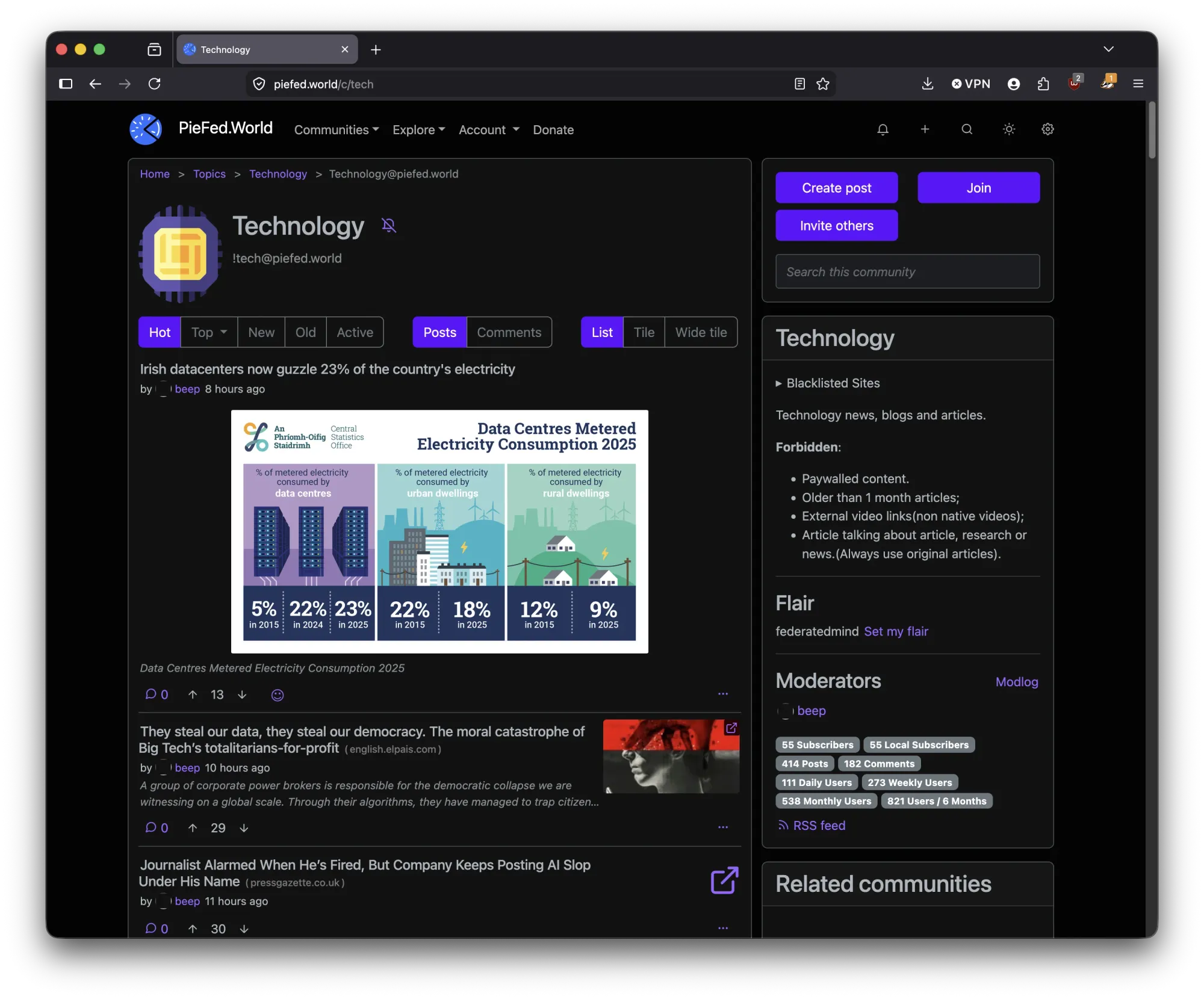
Instances
Piefed.social is the flagship, run by Rimu directly. Feddit.online is a second, independently administered instance, and regional ones have followed since, including piefed.zip in the UK and feddit.fr in France. The full, current list is at join.piefed.social/try.
Clients
No dedicated PieFed app exists yet. Interstellar, the client covered above for Mbin, added support for PieFed's API, which is the more common path here: PieFed leans on general-purpose Threadiverse clients rather than building its own, and that support is still alpha, with an "Unimplemented" error the honest response for whatever the API doesn't yet cover.
Moderation runs on two tiers in Lemmy's model, and Mbin and PieFed follow the same broad shape. Community moderators, appointed by whoever created the community or by an existing mod, handle day-to-day posts and comments, the same role a subreddit mod plays on Reddit. Instance admins sit above them: they can appoint or remove local mods, set rules that apply across every community their instance hosts, and ban users instance-wide. Whoever created the community or the instance sits at the top of that hierarchy, with the power to remove anyone appointed below them.
Moderation
Reddit looks similar on the surface, subreddit mods running their own communities, until you hit the ceiling. Reddit's own admin staff sit above every subreddit mod on the platform, with the power to overrule any of their decisions, and there's no tier below that a mod can appeal to instead. Reddit has quarantined and banned entire subreddits outright when it decided their content crossed a line, sometimes within a day of a triggering event. In every case, the subreddit's own moderators had no recourse, because Reddit is one platform, one company, with one final say. The Threadiverse's version of that same escalation is defederation: an instance admin who decides another instance's moderation has failed can't reach in and overrule its mods the way Reddit's admins can reach into any subreddit, but can cut their own instance off from it entirely. The content and the other instance keep existing exactly as they were; they just stop showing up locally. No single decision-maker can silence a community across the whole network, and no community is fully insulated from every instance choosing to wall it off, either.
The protocol boundary between microblogging and forums turns out to be permeable rather than fixed. Lemmy, Mbin, and PieFed are different applications speaking the same protocol, and the moderation decisions covered above (the defederations, the instance bans, the public mod logs) are what make that decentralization legible.
Who's watching you read?
In late June 2026, Reddit announced that old.reddit.com, the stripped-down interface that had stayed usable without an account long after the main redesign pushed everyone toward logging in, would begin requiring a login to load at all. The change rolls out over the following month, closing anonymous access to the classic interface while reddit.com itself continues to allow logged-out browsing. Reddit framed the change around abuse: in its own words, the logged-out experience on Old Reddit had become "a significant source of abusive scraping and automated traffic." That kind of scraping, per broader coverage of Reddit's fights with AI companies and data resellers, often feeds the same pipelines that train AI models and resell scraped content, though Reddit's own statement doesn't make that connection explicit. Reddit has also said Old Reddit itself might not survive indefinitely.
This is the same lever pulled a third time. Reddit ended most third-party API access in 2023: the first pull. It later closed its unauthenticated data endpoints and started suing companies it accuses of scraping: the second. Now it's Old Reddit's login wall. Determined scrapers register accounts and rotate them; a login wall barely slows them down. The person actually locked out is the lurker, Reddit and Threadiverse shorthand for the anonymous reader who just wanted to read a thread.
A meaningful share of how people actually use Reddit, and the Threadiverse, is read-only, which makes closing that path a real change in what the format allows rather than a cosmetic one.
Lemmy, PieFed, and Mbin haven't made a parallel move to block anonymous browsing of public communities, consistent with how ActivityPub's public timelines are built to work. What Threadiverse instances have tightened, in response to 2023's bot-signup waves, is registration: captchas, sign-up applications, email verification, controls on who can post rather than who can read.
Whatever happened to forums?
Forum communities themselves often point to Facebook Groups and Reddit as the reason niche web forums lost their audience. In this account, around 2010 the same hobbyist and regional conversations that used to live on independent boards moved to these two platforms, drawn by network effects no standalone forum could match. Google compounded it, in the same telling: search results increasingly surfaced Reddit threads over independent forum posts for the same queries, concentrating both traffic and the incentive to post on Reddit instead.
For readers who didn't live through it: phpBB, released in 2000, and vBulletin were the dominant engines behind the web 1.0 and early web 2.0 forum boom, running the regional communities, hobby boards, tech-support forums, and fandom sites that defined that era of the internet. As the commercial forum market shrank, even vBulletin lost ground, this time to XenForo, built by one of its own former developers.
Forums didn't disappear. Reddit is arguably a forum with better distribution than anything that came before it, and plenty of hobbyist and technical communities still run dedicated boards today. The proliferation of small, independent forums declined as two platforms absorbed an audience that used to be spread across hundreds of them.
That's the environment both NodeBB and Discourse were built into: forum engines that started in the early 2010s, during the format's supposed decline, and later ended up running the same protocol as Mastodon.
NodeBB
NodeBB isn't the first platform in this series to bolt federation onto something built years earlier: Part 1 covered both Misskey (built in 2014, adopting ActivityPub in 2018) and Friendica (running since 2010, adopting ActivityPub in 2018) the same way.
Work started in 2013. Julian Lam and two co-founders incorporated the company, NodeBB Inc., in Toronto the following year. It runs discussion communities across gaming, tech, education, and hobbyist niches, the exact audience that used to run phpBB or Discourse.
NodeBB added ActivityPub as a plugin in 2022, then rewrote it into core in v4.0.0, released January 2025. New forums federate automatically, and existing ones toggle it on from Settings → Federation in the admin panel. A federated NodeBB forum exchanges content not just with other NodeBB instances but with Mastodon, Pixelfed, PeerTube, and anything else speaking ActivityPub. Remote, federated content lands in an "Uncategorized" catch-all category with its own pruning logic, a detail that signals a real rewrite rather than a bolt-on.
The community instance, community.nodebb.org, is free to join with no card required (the card prompt belongs to nodebb.com, the commercial hosted product). It has a "World" tab showing a cross-fediverse feed, with Mastodon and Lemmy posts appearing directly inside a forum interface, and a dedicated ActivityPub category with more than 150 topics of admins working through the same questions.
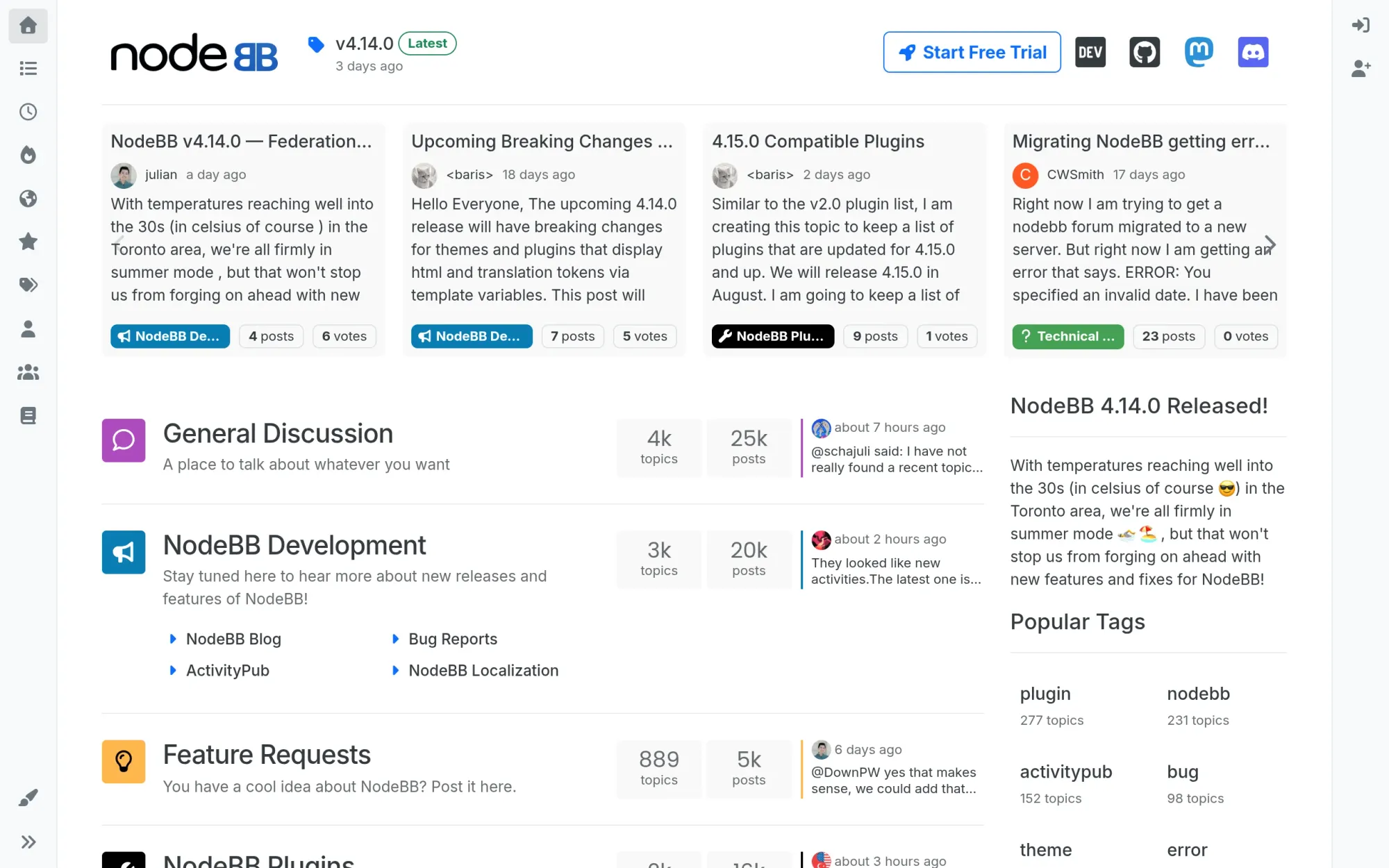
Instances
Community.nodebb.org, covered above, is the project's own flagship. NodeBB.org does list forums running the software, a customer showcase on nodebb.org itself and a fuller list at community.nodebb.org/who-is-using-nodebb, but neither says which of those forums, if any, have federation switched on. Federated NodeBB forums are individual communities running their own hosted or self-hosted install, discoverable mainly through the ActivityPub category on the community instance rather than any central list.
Clients
No official NodeBB mobile app appears in the App Store or Google Play, and no third-party one turned up either. The forum itself is a responsive web app, installable to a phone's home screen as a PWA (progressive web app), a behavior confirmed directly in community.nodebb.org's own page code, which covers most of the ground a native app would.
Discourse
Jeff Atwood, a co-founder of Stack Overflow and Stack Exchange, started Discourse in February 2013 with Robin Ward and Sam Saffron, incorporated as Civilized Discourse Construction Kit, Inc. and backed by First Round, Greylock, and SV Angel. Stack Overflow, which Atwood launched with Joel Spolsky in 2008, had already become the default reference for working programmers, logging more than 24 million questions and 36 million answers over its lifetime, and the Stack Exchange Network it spawned in 2011 extended the same Q&A model across dozens of other technical and hobbyist topics. It was pitched explicitly as a modern reaction against legacy forum software: the same target NodeBB was aiming at, from a different codebase, one year apart. Discourse runs on Ruby on Rails and Ember.js, backed by PostgreSQL and Redis, and was open-sourced in August 2014. Over the following decade it became the default modern forum choice for tech and open-source communities specifically, the dominant "we refuse ancient forum software" option in its category, same as NodeBB.
Discourse joined the fediverse on a longer timeline. Development on an ActivityPub plugin surfaced on Discourse's own Meta community forum in June 2023. Discourse announced it publicly in April 2025, and it went live and testable on meta.discourse.org and early adopter forums like Privacy Guides' community by that May. The plugin, maintained at github.com/discourse/discourse-activity-pub, turns individual categories and tags into followable ActivityPub actors, and admins choose per category whether to federate the full topic (every reply) or just the first post. Federation runs both ways: a remote reply through ActivityPub posts back into the Discourse topic.
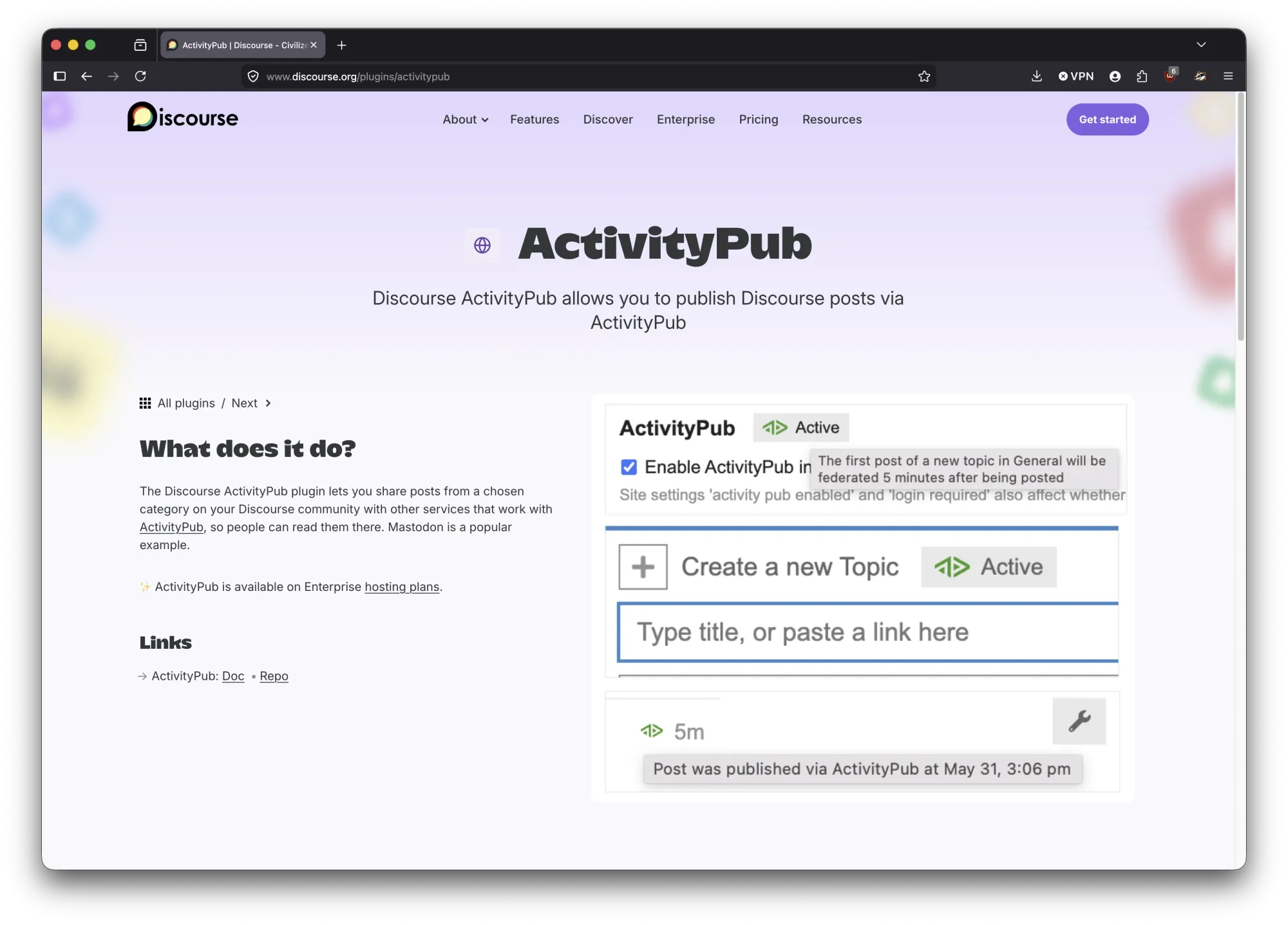
Instances
Meta.discourse.org, covered above, is the project's own reference forum and the best place to watch the ActivityPub plugin running live. "Instances" isn't the right frame beyond that: Discourse runs as thousands of independently operated forums, most with nothing to do with federation, and only a subset have opted the plugin into specific categories.
Clients
Discourse Hub is the official app, on both the iOS App Store and Google Play, and it's built to be one client for many forums at once: add a Discourse site's URL, get push notifications, and switch between communities rather than installing a separate app per forum. It has no ActivityPub-specific behavior; federation is a server-side plugin, invisible from the client's side of things.
Same category of software, founding moments about a year apart, the same reaction against the old forum era, but federation carries different weight in each. NodeBB rewrote its core so every new forum federates by default. Discourse shipped federation as an opt-in plugin that admins enable one category at a time, roughly two years after development first became visible. Neither approach is wrong: one treats federation as foundational, the other as an add-on for the categories that want it.
Forums inherited a different governance shape than the Threadiverse long before either federated. A NodeBB or Discourse forum answers to one operator, with category-level moderators and admin-level bans, not a federation of independently run instances that can defederate from each other the way Threadiverse instances sometimes do. Federation doesn't erase that difference. It means the same single-operator forum can now be followed and replied to from Mastodon, without anyone outside the forum getting a vote in how it's run. Threadiverse communities and forum categories both federate now, but they carried different governance defaults into that federation, and the protocol layered on top of what was already there.
Forum engines built during the format's supposed decline are now running the same protocol as Mastodon, on a different model than Lemmy or kbin. Instead of asking people to migrate to a new, federated platform, forum-style federation asks what if the community someone already belongs to was reachable from wherever they already are.
BookWyrm: social reading without the data broker
Mouse Reeve built BookWyrm as a federated alternative to Goodreads, launching in 2020. Users log books as read, reading, or want-to-read, write reviews, and follow other readers. Shelves are public, and the entire social graph (follows, reviews, reading activity) runs on ActivityPub, so a Mastodon account can follow a BookWyrm account and see its reviews and reading activity appear directly in a Mastodon timeline.
Goodreads gave BookWyrm plenty to be an alternative to. Amazon has owned Goodreads since 2013, and by 2023 the platform had a well-documented review-bombing problem: Elizabeth Gilbert pulled her novel The Snow Forest that June after a wave of more than 500 one-star reviews, what many observers described as review bombing, most from people who hadn't read the book. Moderation stayed thin, and developer-facing features kept getting retired. Then, after the November 2024 US election, backlash over Jeff Bezos and Amazon's involvement in it triggered a fast, real migration away from the platform.
Almost all of that migration went to The StoryGraph, a centralized company run by CEO Nadia Odunayo, not to a federated alternative. The StoryGraph logged roughly 25,000 signups in a single day on November 12, crossed 3 million registered users, and briefly outranked Goodreads on the iOS App Store's book charts.
BookWyrm gets named in the same coverage as the option for readers who want no corporate ownership at all, but public reporting doesn't show a comparable signup spike for BookWyrm itself. Unlike Reddit's 2023 exodus, which was specifically about the federated alternatives, the Goodreads exodus, on the evidence available, mostly skipped the fediverse. BookWyrm's growth looks like a steady, values-driven trickle rather than a crisis-driven wave.
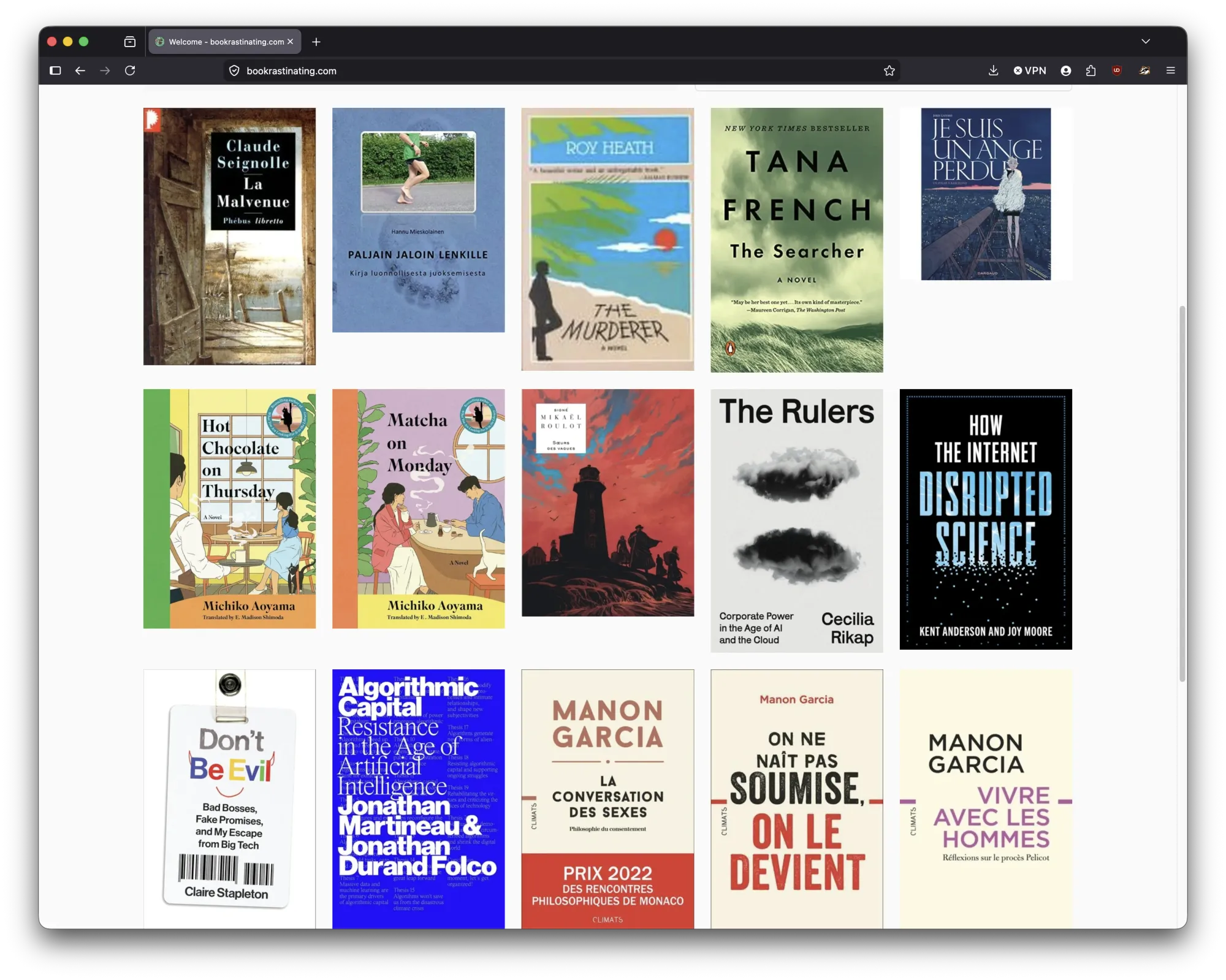
Bookrastinating.com, a social book review site for people who procrastinate on reading or procrastinate by reading, is the largest instance. BookWyrm isn't trying to be social media: no algorithmic feed, no engagement optimization, no infinite scroll, just a reading log that happens to be federated. Mastodon shares short text. PeerTube shares video. BookWyrm shares reading activity. The client on the receiving end displays whatever it knows how to render, which is the real argument for ActivityPub as a general-purpose protocol rather than a microblogging-specific one.
Instances
Bookrastinating.com, covered above, anchors the network. The official instance list is short compared to Lemmy's or Mastodon's, consistent with BookWyrm's slow, values-driven growth rather than a migration wave.
Clients
There's no dedicated native BookWyrm app from the project itself, official or otherwise, just an installable web app that works on Android and iPhone alike. An unofficial Android app is available through F-Droid. Any ActivityPub client that knows how to render reading activity can display a BookWyrm feed without BookWyrm needing to build one.
Music on the Fediverse
We cover Funkwhale, a shared library, and Bandwagon, a storefront.
Funkwhale
Grooveshark shut down in 2015 after a legal settlement with the major labels, and Funkwhale was built the same year by Agate Berriot as a direct, self-hosted replacement. Berriot has said in interviews that Grooveshark's best quality was the social side of listening, its "broadcast" feature specifically, and Funkwhale was designed to carry that forward rather than just replicate a jukebox.
Federation came later, not at the start. ActivityPub support wasn't part of Funkwhale's original 2015 design. It arrived in 2018, which is what makes a Funkwhale channel followable from Mastodon at all. Governance shifted the following year too, from Berriot alone to a French nonprofit, the Funkwhale Collective.
Channels are Funkwhale's most federation-aware feature. A channel is followable directly from Mastodon, and new track uploads appear as posts in a follower's home timeline, the same pattern BookWyrm illustrates for reading activity. Peer-to-peer library sharing between Funkwhale instances is also possible, independent of that social layer entirely.
It stays small by any measure: somewhere around 80 active instances and a few hundred active accounts, depending on which tracker is doing the counting (see the stats table above). That's the smallest footprint of any platform here, smaller than Mbin. The project is still actively developed, not a legacy artifact: documentation updates and roadmap discussion tied to a 2.0 release cycle, with development activity as recently as March 2025, and its own stated direction is to extend ActivityPub further into its internal mechanisms rather than stop at the channel-follow feature.
Instances
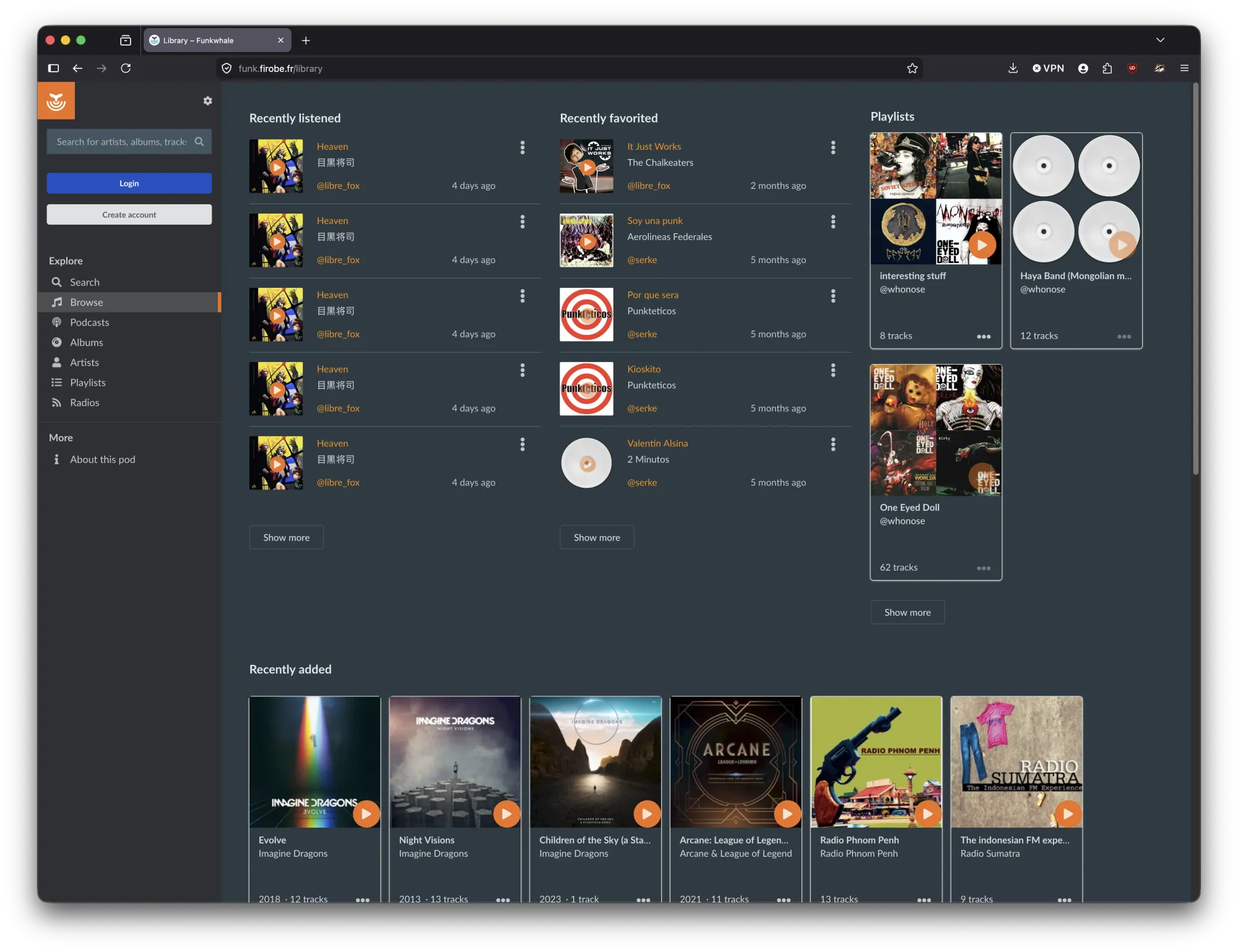
Funk.firobe.fr, covered above, is one of the self-hosted pods running today. Funkwhale's own pod list tracks the rest, most run by individuals or small groups for their own libraries rather than as general-purpose signup destinations, consistent with a project this size.
Clients
Funkwhale for Android is the project's own official app, written in Kotlin against Funkwhale's native API. There's no official iOS client, but Funkwhale has shipped a subset of the Subsonic API since 2018, a de facto standard other music servers use too, which opens the door to Subsonic-compatible apps like Ultrasonic and Substreamer on both Android and iOS. The protocol layer outlives any single client's roadmap.
Bandwagon
Bandwagon starts from a different premise entirely: not a shared library to stream, but a storefront musicians sell directly from. It's built on Emissary, a programmable ActivityPub server created by developer Ben Pate for building purpose-specific fediverse apps rather than one general-purpose platform. Bandwagon, launched to serve musicians, is the first app he's shipped on it. It grew out of FediForum, a recurring virtual fediverse developer conference, where organizers were looking for an open alternative to the major music platforms around 2024. Pate was there to pitch Emissary itself, and adopted that as his flagship use case. He builds and runs Bandwagon as a solo developer, not a company or nonprofit. His motivation is the same complaint driving a lot of fediverse migration generally: watching corporate platforms degrade for their users, and wanting something as open as WordPress but as easy to sign up for as Facebook.
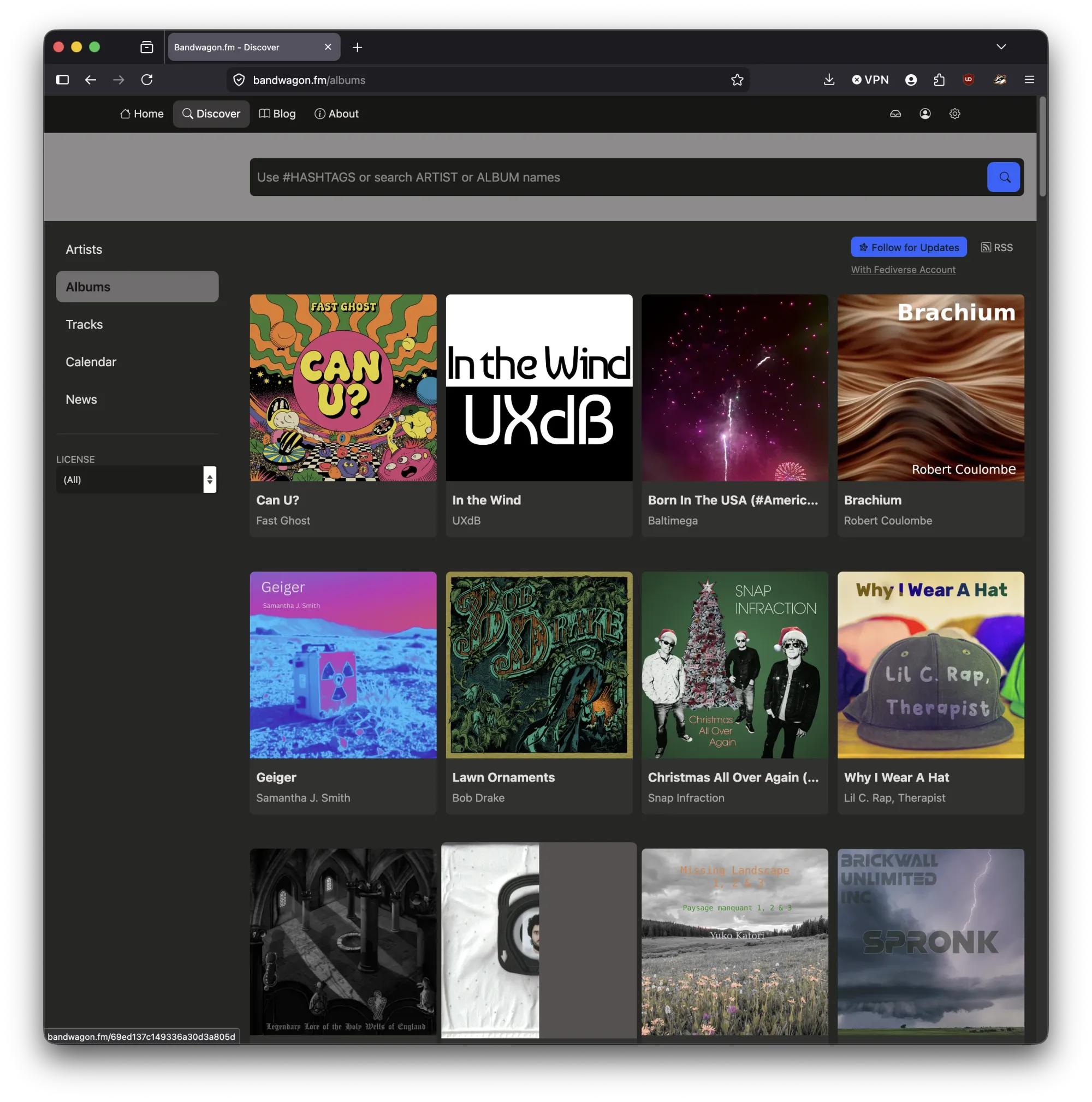
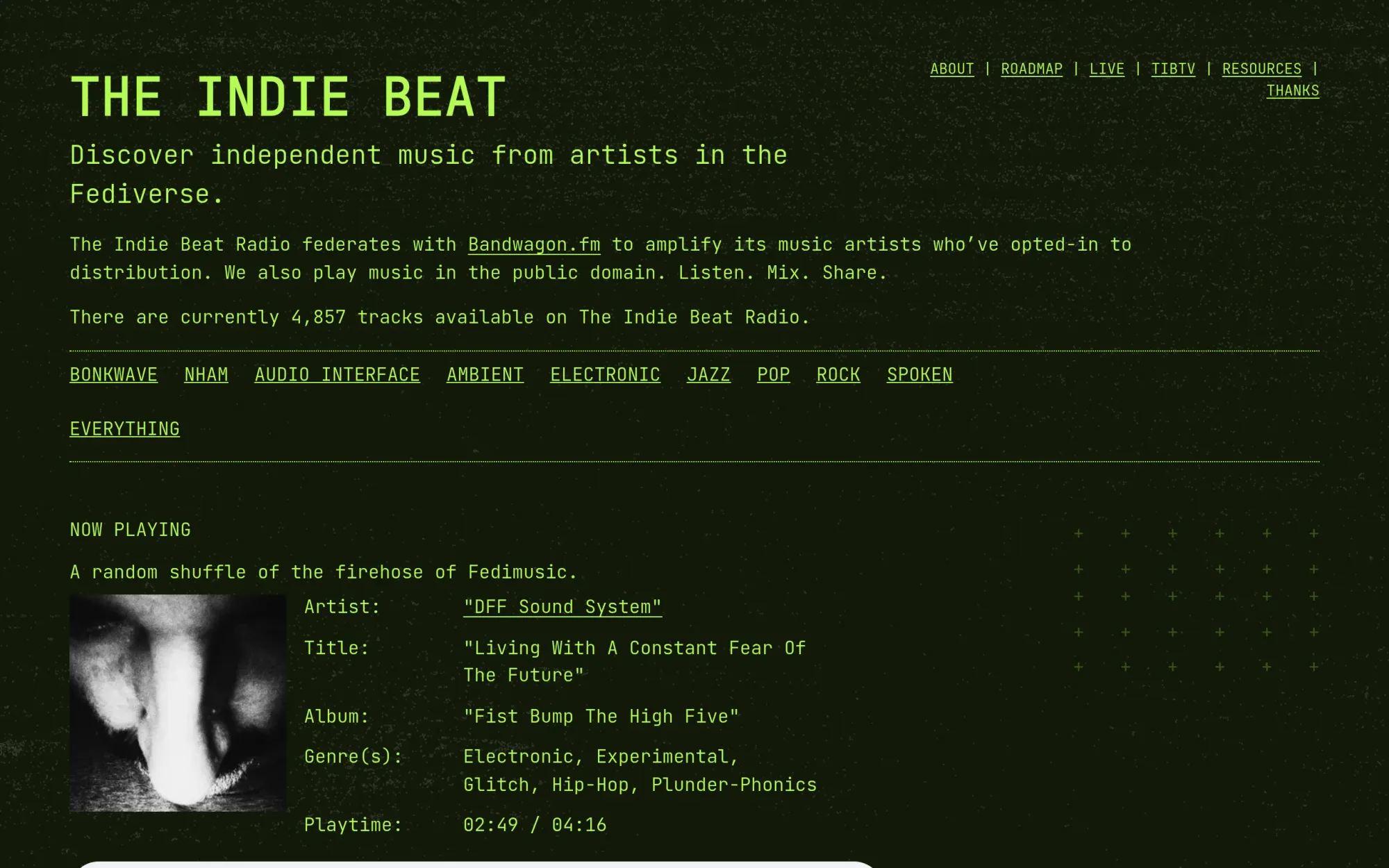
Bandwagon and Emissary are open source and self-hostable too, the same as Funkwhale. In a July 2026 conversation with Federated Mind, Pate said he's willing to help anyone who wants to set up their own Bandwagon server. According to Pate, Bandwagon has over 750 registered bands as of this writing, with roughly 400 of them, about half, publishing a public profile on the site, a ratio that has held steady for a while. Artists who opt in can also get airplay on The Indie Beat (theindiebeat.fm), an independent internet radio station that streams from Bandwagon's opted-in catalogue alongside public-domain tracks, playing from a pool of roughly 4,800 songs.
Bandwagon announced a payment system in mid-2025, covered at the time by the fediverse news site We Distribute. The model was a hybrid of Bandcamp and Patreon: musicians would sell individual tracks, EPs, or full albums, and set up ongoing "Support Levels" with monthly billing, while a "Circles" feature would let paying followers get exclusive drops, rare tracks, and behind-the-scenes posts. Basic sales already work, Pate says: bands are selling music on Bandwagon now, just at a smaller scale than indie platforms like Mirlo.
The model taking shape is freemium, not a sales commission. Online sales, higher-bandwidth streaming, Bluesky integration, and an embeddable player are all free for now, a feature set Pate is still testing, with some of it moving behind a paid "Bandwagon Premiere" tier once that ships. "I'm more comfortable with no commission because I don't want to get in between people and their money," he said. "Instead, the platform should provide its own value regardless of sales." He's in no hurry to launch the paid tier either: "there's too many other things to do, at the moment, so I'm not really rushing paid subscriptions out the door just yet."
Pate had told We Distribute that Bandwagon will integrate with payment processors but "will never depend on any one specific company," to keep any single provider from gaining leverage over independent artists. That's shifted since that report: Stripe support is now live, but PayPal was tried and then dropped. Pate says he's optimistic about adding at least one more payment alternative by the end of 2026, in keeping with that same goal.
Pate is direct about why the payment layer matters more than catalogue size: "For the Fediverse to grow and thrive, there has to be a way for people to earn money with their creative content. This is true not just for creators, but for the people who will find and follow them here as well." Bandwagon is also the first of what he describes as a family of Emissary-based apps: a second one, Qwertylicious, is planned for long-form writers, mixing free and subscription content, still unreleased as of this writing.
Between them, Funkwhale and Bandwagon close the loop on ownership. Funkwhale already keeps the library out of any single company's hands. Bandwagon is built to do the same for music payments, with no record label, app store, or payment monopoly standing between a musician and the person paying them.
The Long Tail
Four posts now map onto the same shape. Part 1 covered the microblogging forks (Misskey, Sharkey, Iceshrimp, Pleroma, Akkoma, Friendica, Hubzilla, GoToSocial), the fediverse's answer to Twitter and X. Part 2 covered Pixelfed, Loops, PeerTube, and Owncast, the fediverse's answer to Instagram, TikTok, YouTube, and Twitch. Part 3 covered Ghost, WriteFreely, Micro.blog, WordPress's ActivityPub and AT Protocol plugins, and Flipboard, the fediverse's answer to Substack, Medium, and WordPress.com itself. This post covers Lemmy, kbin, Mbin, and PieFed, NodeBB and Discourse, BookWyrm, and Funkwhale and Bandwagon: the fediverse's answer to Reddit, phpBB- and vBulletin-era forums, Goodreads, and Spotify.
The map keeps going past those four categories too: Mobilizon runs federated event planning, Castopod runs federated podcast hosting, Wanderer runs a federated GPS trail database for hikers, Pinka bridges blog comments into Mastodon replies, and flohmarkt runs federated classified ads.
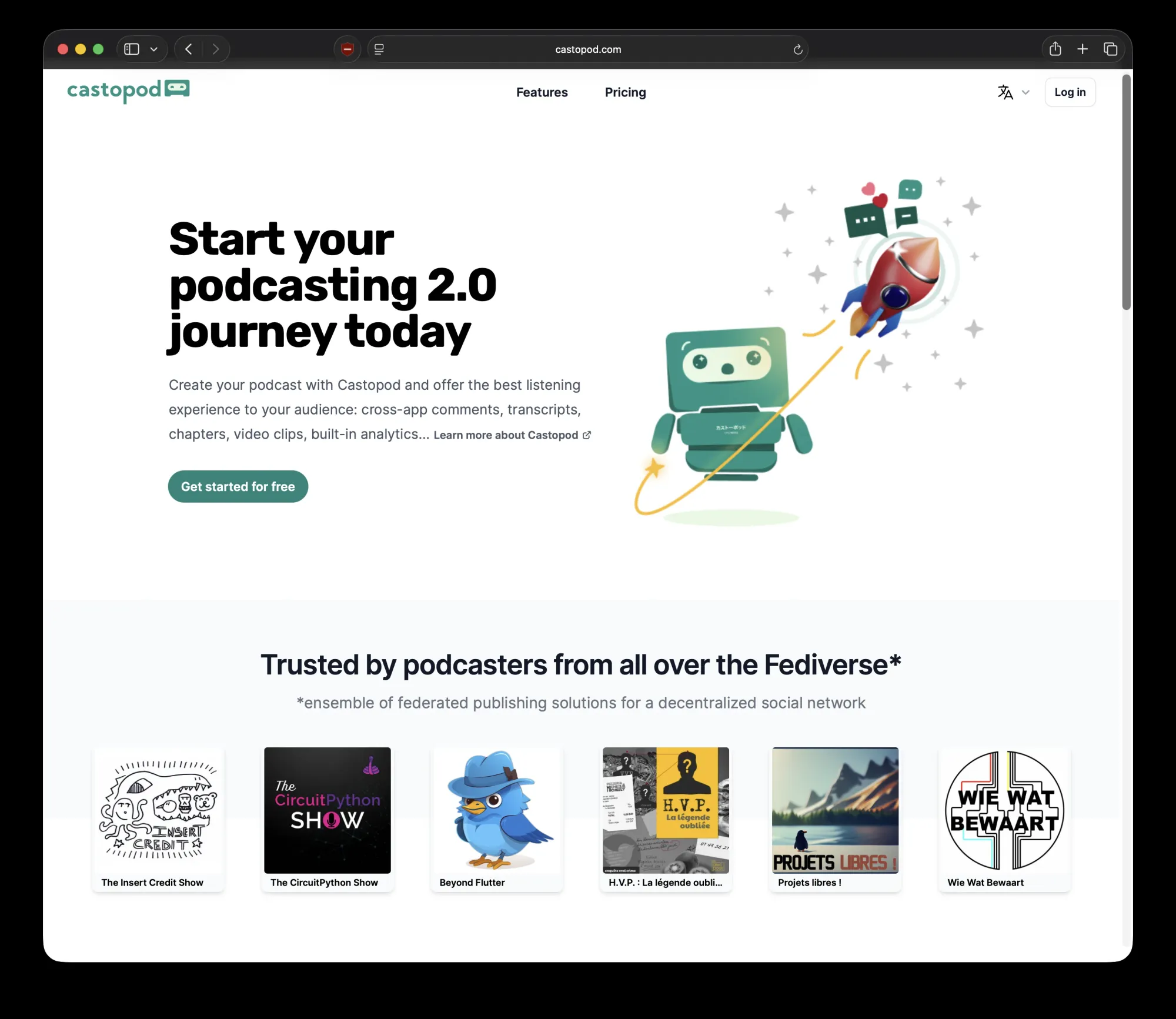
A handful of exciting projects among the plethora of fediverse software already out there, all on the same protocol.
The protocol argument
The 2022 coverage frame, Mastodon versus Twitter, captured a real moment but missed the bigger one it belonged to. Mastodon was the most visible application of a protocol that had already been running most of what social media promised, across formats, for years before most people noticed.
The case for any of this was never that the federated alternatives are better products. By mass-adoption metrics, in most categories covered across this series, they aren't. The case is structural: the protocol layer belongs to nobody. No company can revoke API access. No acquisition can change the terms. No algorithm sits between a follower and the account they chose to follow. It's closer to email than to social media, a protocol that persists because it's useful, not because one company controls it.
What's next: this closes out The Fediverse Beyond Mastodon. Catch up on any part of the series via the fediverse-beyond-mastodon tag, or follow the exploring-the-fediverse tag for what's next.
Sources and further reading
Reddit API changes and the 2023 exodus
- Reddit API controversy — Wikipedia
- Reddit Stands By Controversial API Changes As Subreddit Protest Continues — Forbes
- Reddit Blackout Rolls On For More Than 5,000 Subreddits — Forbes
- Everything You Need To Know About the Reddit API Changes — Nordic APIs
- Timeline: the crisis and moderators' revolt against Reddit's hefty API changes — PRWeek
- Twitter under Elon Musk — Wikipedia
Lemmy, kbin, and Mbin
- Lemmy (social network) — Wikipedia
- Dessalines — lemmy.ml/u/dessalines
- Nutomic — lemmy.ml/u/nutomic
- Update from Lemmy after the Reddit blackout — join-lemmy.org
- Exploring the fediverse: Lemmy's surge and stagnation — KrAsia
- The Kbin Experience — Roundcat's Blog
- Lemmy and Kbin — Fediverse Report
- What happened to kbin? — Lemmy.World discussion
- Mbin — GitHub
- About me — Ernest Wisniewski (ernest.dev)
- PieFed — codeberg.org/rimu/pyfedi
- join-lemmy.org instance list
- Jerboa — lemmy.ml/c/jerboa
- Interstellar — GitHub
- After Radio Silence, Kbin App Artemis Shuts Down — We Distribute
- join.piefed.social/try — PieFed instance list
- Lemmy Moderation — join-lemmy.org docs
- Controversial Reddit communities — Wikipedia
- Quarantined Communities — Reddit Help
- Content Moderation, Enforcement, and Appeals — Reddit Help
Reddit's login wall
Forum history
- Why did phpBB forums go out of fashion? — Hacker News
- Has anyone noticed a decline in forums? — XenForo community
NodeBB
- Binpress Podcast Episode 4: Julian Lam of NodeBB
- NodeBB — GitHub wiki history
- docs.nodebb.org/activitypub
- NodeBB Officially Joins the Fediverse — We Distribute
- Forum software NodeBB joins the fediverse — TechCrunch
- NodeBB.org homepage showcase and Who is using NodeBB — community.nodebb.org
Discourse
- Discourse (software) — Wikipedia
- Stack Exchange Co-Founder Jeff Atwood Launches Forums Startup Discourse — TechCrunch
- Stack Overflow — Wikipedia
- Stack Exchange — Wikipedia
- Discourse and the Fediverse! — Discourse blog
- discourse-activity-pub — GitHub
- Discourse Hub — App Store
BookWyrm and the Goodreads exodus
- BookWyrm is a federated Goodreads replacement — Hacker News
- Why some book fans are leaving Amazon-owned Goodreads — CBC News
- Bye, Bezos: People Are Leaving Amazon's Goodreads — HuffPost
- The StoryGraph and BookWyrm, Goodreads alternatives — Ground News
- Goodreads has a 'review bombing' problem — NPR
- Goodreads was the future of book reviews. Then Amazon bought it. — Washington Post
- joinbookwyrm.com/instances — official instance list
Funkwhale
- docs.funkwhale.audio
- Funkwhale, an Open Source GrooveShark Alternative, Begins ActivityPub Implementation — We Distribute
- Funkwhale, les défis d'une version libre et fédérée de Grooveshark — Next.ink (2018 interview with founder Agate Berriot)
- Connect to Funkwhale from other apps — funkwhale.audio
- Funkwhale pod list
Bandwagon
- Bandwagon.fm
- Emissary — emissary.dev
- Bandwagon is Bringing Music Sales to the Fediverse — We Distribute
- The Indie Beat
- Ben Pate of Bandwagon.fm - Crafting a New Site for Musicians — The Lorenzo's Music Podcast
- Pate's "will never depend on any one specific company" quote is from the We Distribute article above. Everything else attributed to Pate directly in the Bandwagon section, the self-hostability confirmation, the 750/400 band figures, basic sales already working, the freemium model and its two direct quotes, and the "For the Fediverse to grow and thrive..." quote, comes from a series of direct conversations between Ben Pate and Federated Mind in July 2026, not a published interview.
Other federated formats (brief mentions only)
- Mobilizon — federated event planning, Framasoft
- Castopod — federated podcast hosting
- Wanderer — federated GPS trail database
- Pinka — ActivityPub commenting bridge for static sites
- flohmarkt — federated, self-hostable classified-ad software
Fediverse statistics
Cross-references in this series
Subscribe and catch up on any part of the series via the fediverse-beyond-mastodon tag, or follow the exploring-the-fediverse tag for what's next.