
The Written Fediverse: Where the Words Live
Ghost, WriteFreely, Micro.blog, Plume, WordPress, and Flipboard didn't all arrive at federation the same way. Some built it in from the first commit. Some bridged it onto a product that already existed. Federation decides how far the writing travels.

Part 3 of The Fediverse Beyond Mastodon. This series is part of the Exploring the Fediverse umbrella. The Visual Fediverse covered where photos and video live on the fediverse. This one is about long-form text.
Text was ActivityPub's first real workload: a Mastodon post is just a few hundred characters of JSON. But purpose-built writing platforms, the ones built for blogs, newsletters, and long-form publishing, didn't all arrive at federation the same way. Some built it in from the first commit. Some bridged it onto a product that already existed. One pointed its own users toward its competitors rather than keep maintaining it. And at least one company almost inherited federation by accident, then changed its mind.
Where things stand
Of the platforms covered here, only WriteFreely shows up cleanly on the standard fediverse trackers, at somewhere between roughly 320 and 900 active servers depending on which one you check; Ghost and WordPress federate as single site-level actors that trackers count as publisher sites rather than people, and Micro.blog, Plume, and Flipboard don't register on any tracker at all, for reasons covered in their own sections below.
Ghost
Ghost is run by the Ghost Foundation, a UK-registered non-profit rather than a venture-backed company. It announced it was building ActivityPub support in April 2024, ran the project as a public build-in-progress for over a year, and shipped it as a stable feature in Ghost 6 in August 2025. The announcement post framed the whole effort as a return to first principles: "We had it pretty good for a while, back there. The early days of the web were chaotic, free, and open... Then the social networks came."
Ghost is also the platform this publication runs on. The technical walkthrough of that setup is reserved for Deep Dive posts planned later.
Under the hood, Ghost's ActivityPub layer isn't bolted directly into the core Node.js application. It's a separate, multi-tenant ActivityPub server built with Fedify, a framework specifically designed for building ActivityPub servers, that Ghost sites connect to. Ghost doesn't just use Fedify: it funds the project directly, an arrangement Fedify's creator, Hong Minhee, confirmed after Ghost's team announced the decision to build on it in June 2024. The toggle lives in Settings → Network: "Distribute posts to the social web." Turn it on, and the site gets an ActivityPub actor: a first-class fediverse identity, followable from Mastodon, Pixelfed, or any other ActivityPub client, with no plugin and no separate account required. @index@federatedmind.com is followable from any Mastodon-compatible app right now, because this site runs on exactly that software.

Ghost's own copy on this screen names the platforms this one toggle reaches: Flipboard, Mastodon, Threads, Bluesky, and WordPress. Ghost's FAQ page rejects the assumption that ActivityPub is only a microblogging protocol: Mastodon and Threads happen to be built around short posts, Pixelfed around images, PeerTube around video, and Ghost is building toward long-form, rich content on the same wire format.
What a fediverse follower actually sees when a post goes out is less settled than the toggle makes it look. Ghost federates each post as an ActivityPub Article object carrying the title, the excerpt, and the full post content all at once. Mastodon, the client most fediverse readers will use, has no first-class support for the Article object type and falls back to a best-effort conversion. Ghost users testing this in the weeks after the Ghost 6 launch found that many Mastodon apps and instances render the entire article directly in the timeline rather than an excerpt-and-link preview. Which one a given reader gets currently depends on their client, not on anything the publisher sets.
In Ghost's current implementation, the excerpt half of that behaves consistently. A Ghost post's excerpt, the same text reused for on-site previews and newsletter subject lines, doesn't render links as clickable URLs: type one in, and it shows up as plain text everywhere that excerpt gets reused. Because ActivityPub pulls the object's summary from that same field, anyone following @index@federatedmind.com sees the identical, link-free excerpt this site already shows in its own newsletter.
Ghost built an inbox as well as an outbox: a dedicated ActivityPub feed inside the admin interface lets you follow other people, publications, and topics from across the fediverse and read them in the same place you write. That makes Ghost simultaneously a publisher and a fediverse client, which none of the other platforms here attempt: WriteFreely and WordPress all publish outward, but they don't build a reading experience for everyone else's posts into their own interface. Ghost's pitch is that subscribing to a Ghost site by ActivityPub and by email end up as the same thing on the backend: both are registered Ghost members, so the same comment threads, likes, and paid-subscription gating apply regardless of how someone found you. Ghost has also said gated, paywalled content is meant to work over ActivityPub eventually, not just free posts. The details of how that reconciles with an open protocol are still being worked out.
Bluesky works differently: Ghost doesn't speak AT Protocol natively, and instead bridges to Bluesky through Bridgy Fed, the same bridge The Bridge to Bluesky covered in depth: enabling the "Bluesky sharing" preference in Network settings has your Ghost actor follow @bsky.brid.gy, which is what makes the site followable from Bluesky. It works, and readers on either network can find you, but it's a bridge sitting on top of ActivityPub rather than a second protocol implementation: Ghost is one of three approaches to AT Protocol here, and the only one of the three that routes through a bridge instead of speaking the protocol directly.
WriteFreely
WriteFreely has one primary maintainer, Matt Baer, who accounts for roughly 1,400 of the repository's 1,900-plus commits. He's maintained the project since 2015, when it started as Write.as: a hosted, deliberately minimal writing platform that began as an anonymous-posting tool and grew into something closer to a distraction-free blog. In 2018, Baer open-sourced the underlying software as WriteFreely and wired it into the newly emerging fediverse, giving it native ActivityPub federation from that point forward. It's the same shape as dansup and Pixelfed from The Visual Fediverse, the previous part of this series: one person, sustained for the better part of a decade, financially backed by their own company rather than outside investors. Write.as is that company: the hosted product that funds Baer's continued work on the open-source WriteFreely codebase.
Write.as is turnkey: sign up, write, it federates. WriteFreely is what you get when you self-host the same software: full control, your own domain, your own moderation, at the cost of running a server yourself. Same code, same federation, different amount of responsibility.
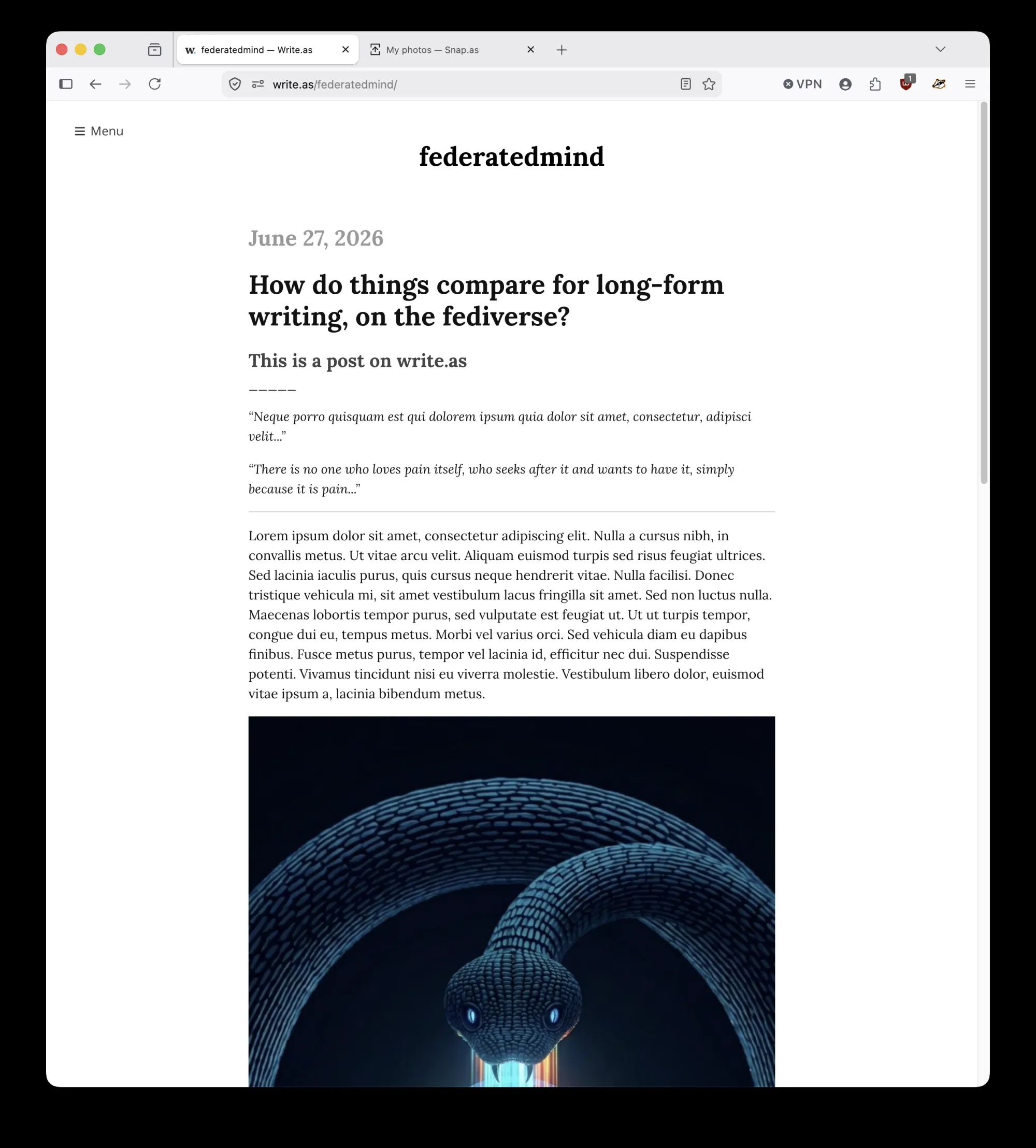
Fediverse.observer puts active WriteFreely servers at roughly 320. libera.site, a separate tracker dedicated to WriteFreely specifically, reports a much larger active network: as of July 2026, 896 instances and roughly 303,000 users. The gap between the two looks less like one tracker being wrong and more like each one drawing its "active" threshold differently, with fediverse.observer's narrower crawl excluding a large share of smaller or intermittently-reachable instances that libera.site still counts. Separately, Write.as has said it powers over 550,000 hosted blogs cumulatively, a figure that measures something else again: every blog ever created on the hosted product, not accounts currently federating, and shouldn't be read as a fediverse-activity number. Until a single source reconciles the instance-count gap, libera.site's total is the more current figure to lead with, with fediverse.observer's count as the conservative floor.
snap.as, the minimalist photo-sharing tool covered alongside Pixelfed, is Write.as's visual companion product, built by the same team and sharing the same aesthetic.
Instances
The public directory at writefreely.org/instances lists self-hosted communities beyond Write.as itself, ranging from single-user personal blogs to focused communities like Noblogo.org, an ethical, non-profit WriteFreely network built around "no spying, no personal data collection, no premium costs." Because a WriteFreely instance is lightweight to run (a small Go binary, SQLite-friendly), most of what's in the directory is one person hosting a handful of writers rather than the large flagship instances you'd see on Pixelfed or Mastodon.
Clients
WriteFreely ships an official iOS/iPadOS/macOS app, built with SwiftUI as a multiplatform client, that works against both Write.as and any self-hosted WriteFreely instance, a one-time $11.99 purchase rather than a subscription. There's no official Android app. That matters less than it might on other platforms: a WriteFreely post is just a federated blog post under the hood, so it's readable and repliable from any Mastodon-style client regardless of what device you're on. For most readers, the "client" is whatever fediverse app they already use.
Micro.blog
Micro.blog started as a Kickstarter campaign Manton Reece launched on January 2, 2017, bundling the platform together with an accompanying book, Indie Microblogging. Reece brought an existing audience to the campaign: a decade as an indie Mac and iOS developer with apps like Tweet Library and Clipstart, and years co-hosting the podcast Core Intuition with Daniel Jalkut. The campaign hit its $10,000 goal on day one and closed 30 days later at $86,696 from 3,080 backers, enough to fund a community manager before the product had a single user. The platform launched publicly in April 2017 and opened fully beyond beta and Kickstarter backers by late 2018. Pricing as of mid-2026 starts at $5/month for hosting; the underlying protocol support is free either way.
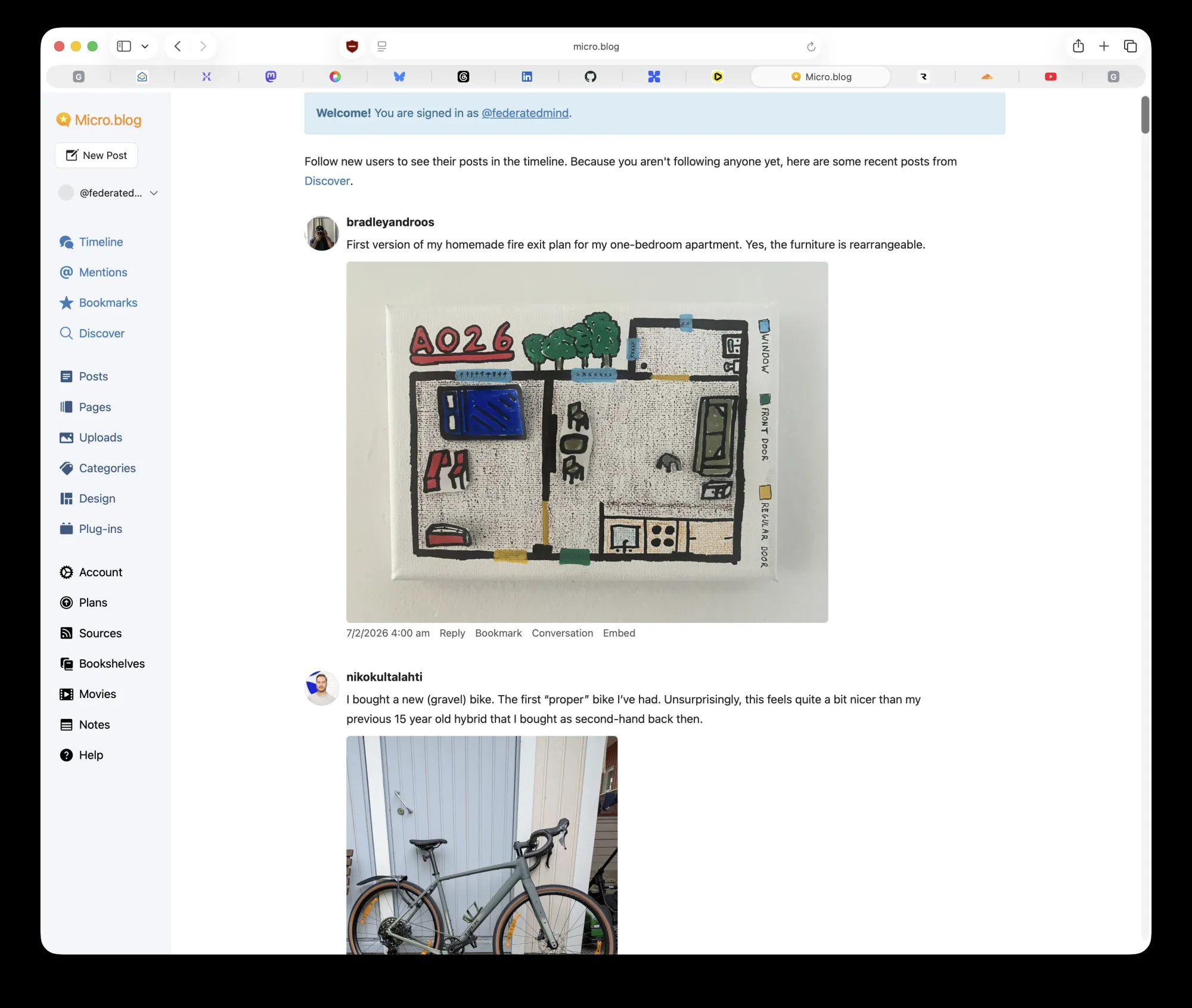
Despite the name, Micro.blog isn't limited to microblog-length posts. Its own homepage puts it plainly: "Blogging is at the heart of Micro.blog. Short microblog posts or long-form posts." Leave a post untitled and it behaves like a short status update; give it a title, and it becomes a full blog entry with no length limit, indistinguishable on the actual site from a WriteFreely or WordPress post. That distinction matters most on the federated timeline: an untitled post under 300 characters displays in full, but a titled long-form post shows up there as just the title and a link back to the site, not the content itself. Long-time users have pushed Micro.blog to change that timeline treatment for years without much movement, so anyone publishing long-form content through Micro.blog should expect Mastodon and Bluesky followers to see a link post, not a full article, in their feed.
Reece built Micro.blog out of the IndieWeb tradition rather than the ActivityPub-first tradition that produced Mastodon and WriteFreely. That lineage shows up in its defining feature: POSSE, short for Publish on your Own Site, Syndicate Elsewhere. You write once, on your own domain, and Micro.blog pushes copies out to Mastodon, Bluesky, Tumblr, Flickr, and other services automatically. Your site stays the canonical source. Everything else is a syndicated copy.
Micro.blog integrates directly with both ActivityPub and Bluesky's AT Protocol APIs, without relying on a bridge. ActivityPub support puts Micro.blog posts in Mastodon timelines the same way Ghost's does. But Micro.blog also added direct Bluesky support in April 2023: Reece has written about his appreciation for how closely Bluesky's domain-based identity model tracks IndieWeb principles Micro.blog was already built around. Micro.blog isn't itself an AT Protocol personal data server the way Bluesky's own stack or AT-native platforms like Leaflet and Offprint are; it's a blogging platform that cross-posts into both networks directly from its own code. Two protocols, two direct integrations, one publishing action: nothing else surveyed here does that without routing through a third-party bridge.
The Visual Fediverse mentioned Micro.blog's Flickr crossposting almost in passing: publish on Micro.blog, and it syndicates to Flickr alongside everywhere else, with the caveat that Micro.blog strips EXIF metadata from crossposted photos for privacy. That's one spoke of a much larger POSSE wheel: the same mechanism handles Mastodon, Bluesky, Tumblr, and more, all from one editor.
Instances
Micro.blog has no self-hosted instances of its own, unlike WriteFreely or Plume: the hosted service is closed source, and there's no public repo for the backend running micro.blog. Micro.blog's client apps are open source (Manton Reece released the iOS and Mac app code in 2021), but that covers the apps, not the platform itself. Self-hosting is still possible in a narrower sense, though it means self-hosting a Micropub-compatible blog rather than a Micro.blog server, since Micropub is an open spec independent of Micro.blog: Indiekit and the official WordPress Micropub plugin both let anyone run a Micropub-compliant endpoint and publish to it with the same client apps covered below, without touching Micro.blog's own product.
Clients
Beyond the official iOS, macOS, and Android apps, Micro.blog has an active third-party app ecosystem: Micro Social and Icro for iOS, Mimi Uploader for batch photo posting, and web clients like Lillihub and Micropublish. Writing apps including Ulysses, iA Writer, and Drafts can publish straight to a Micro.blog account, and MarsEdit covers full-featured macOS blogging. The common thread is Micropub, an open IndieWeb-standard API for posting to a blog. Micro.blog supports it natively, which is what lets this ecosystem exist without Micro.blog having to build every client itself.
Plume
Plume is a federated blogging engine written in Rust, built on the Rocket web framework with Diesel for its database layer. Its defining feature, and the one thing absent from every other platform covered here, is native support for collaborative, multi-author blogs: several writers sharing and improving the same publication from the start, rather than each author running an isolated single-voice site.
Plume's own homepage states its status plainly: "Plume is not actively maintained. New features may take time to be implemented." It goes on to recommend "similar purpose software: WriteFreely, WordPress with ActivityPub plugin," directing its remaining users elsewhere.
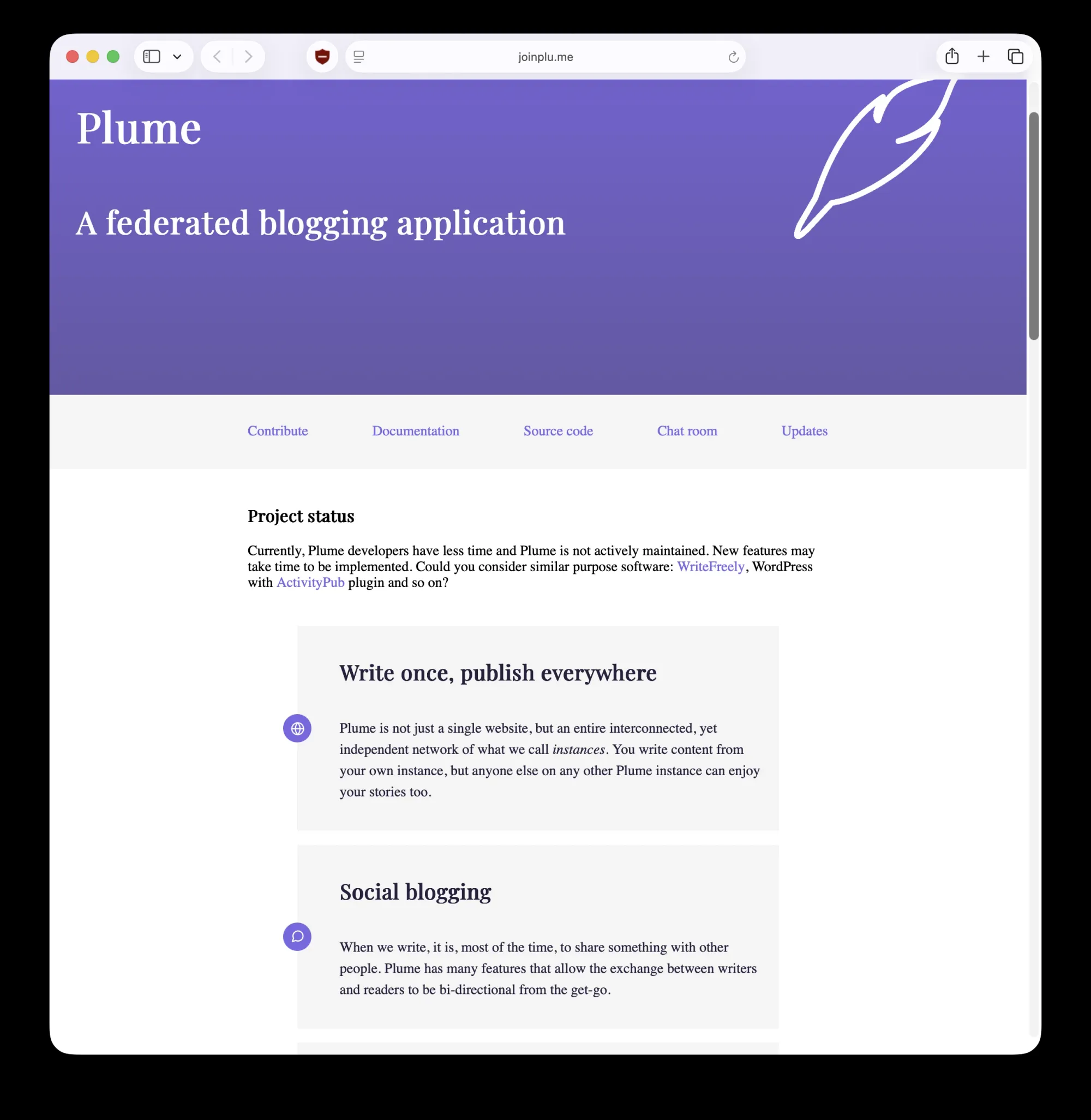
Plume isn't dead. A real, if small, network of instances is still running, including some of the fediverse's oldest surviving blogging communities. But the project's own maintainers pointed their remaining users toward WriteFreely and WordPress themselves.
Instances
The network is thin, and many instances on Plume's own list have gone quiet. As of mid-2026, at least one Portuguese-language instance, amplifi.casa, was still posting, though its content wasn't reviewed beyond confirming activity. Anyone curious what else is currently running is better off checking joinplu.me directly than trusting any specific instance link in a blog post, since small, self-hosted instances like these come and go.
Clients
There isn't one. Plume runs entirely through the browser, with no dedicated mobile app, official or third-party. That's consistent with the project's overall trajectory: the energy that would build a client ecosystem is exactly what the maintainers say they no longer have. Posts are still readable and repliable from any ActivityPub client that supports long-form content, which is the one piece of this platform that doesn't depend on Plume's own team continuing to build anything.
Tumblr, Automattic, and the WordPress bridge that already exists
In August 2024, Automattic announced it would migrate Tumblr's backend (half a billion blogs) onto WordPress infrastructure. The company was explicit that Tumblr's front-end experience wouldn't change; this was purely an infrastructure move. But running on WordPress's backend would have made Tumblr federation-capable too, inheriting whatever ActivityPub support WordPress already had.
That migration is now on indefinite hold. In July 2025, Automattic CEO Matt Mullenweg told The Verge's Decoder podcast the project had been deprioritized: "more like an infrastructure thing, kind of like any big re-architecture." Asked directly about what this meant for Tumblr and the fediverse, he added: "in the meantime, I think if there was a big push to implement fediverse, we would just do it on the Tumblr code base." Federation was never strictly gated on the migration completing. It's simply not a current priority, on either code path.
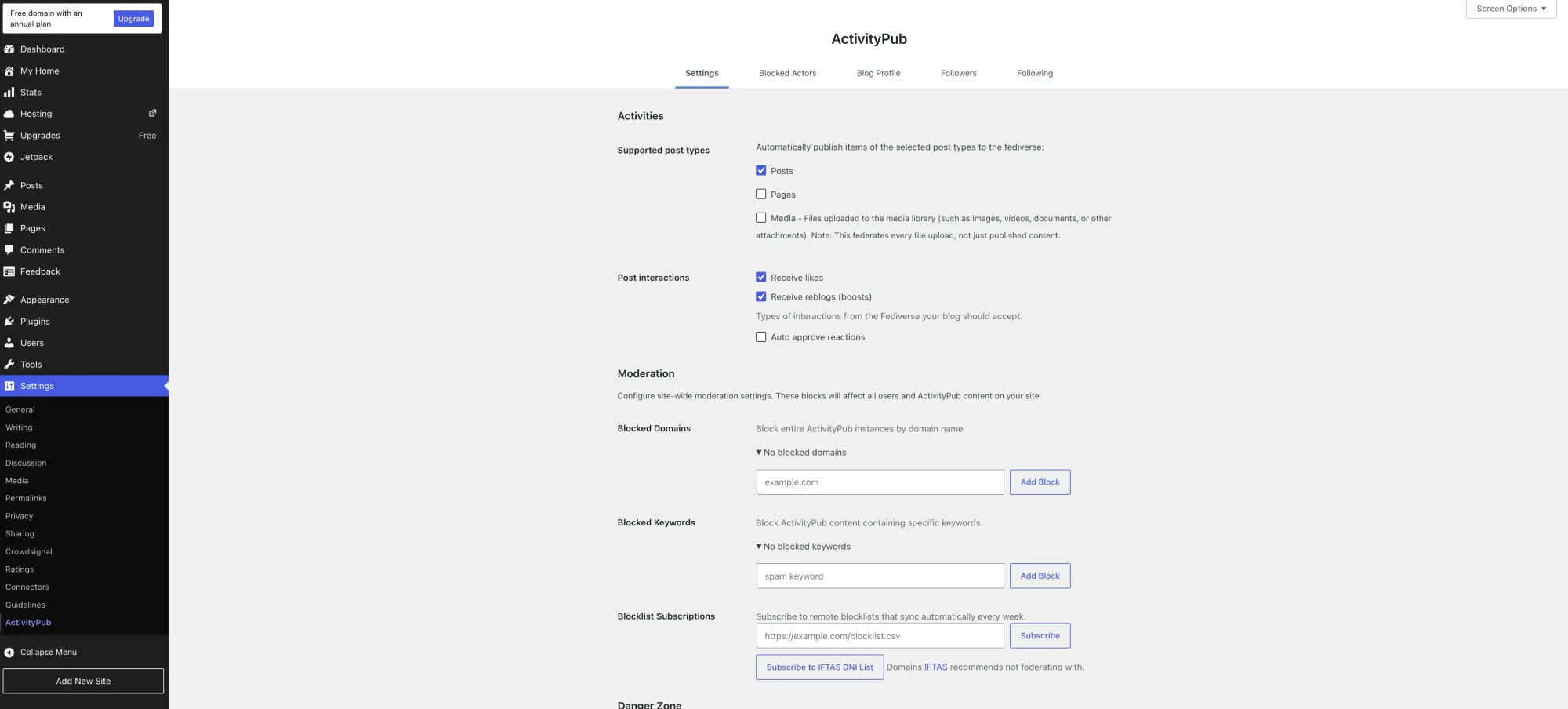
Whatever Tumblr might eventually inherit already exists today at WordPress.com, the other blogging platform under Automattic's ownership. WordPress.com ships ActivityPub as a built-in, no-plugin-required feature. Any site owner can go to Settings → ActivityPub and click "Join the Open Social Web" to get a blog-level Fediverse identity (blog@yourdomain.com) with zero configuration. Sites on plugin-enabled tiers get more: individual per-author identities (username@yourdomain.com), global controls over which post types federate by default, and per-post visibility settings (public, quiet public, or do-not-federate). New posts federate automatically, typically within about 15 minutes; existing posts aren't backfilled.
The same settings screen includes real moderation tooling: site owners can block specific domains or keywords outright, and subscribe to remote blocklists that sync automatically on a weekly schedule, including a one-click subscription to the IFTAS DNI list, a curated list of domains recommended for defederation maintained by IFTAS (Independent Federated Trust and Safety), a nonprofit that supports fediverse moderators.
Matthias Pfefferle started blogging on WordPress's predecessor, b2, back in 2002, switched to WordPress in 2004, and built his first WordPress plugin in 2007: the same trajectory of long-running personal-blogging obsession that produced Matt Baer's WriteFreely. Pfefferle began building ActivityPub support for WordPress on his own in 2019, years before Automattic had any official interest. In 2023, Automattic hired him full-time to keep doing exactly that work, folding what had been an independent developer's plugin into the company's own open-web strategy. Where WriteFreely and Plume stayed independent (one thriving on its own, one fading without institutional support), WordPress's federation story is what happens when a company decides to formally absorb the person already doing the work instead of building a competing team from scratch.
The AT Protocol side runs through an entirely separate mechanism, not to be confused with the ActivityPub toggle. Automattic's official ATmosphere plugin implements AT Protocol natively, not a bridge, not a proxy. It cross-posts WordPress content directly to Bluesky, registers each post as a standard.site document on your own personal data server, and lets you use your own domain as your Bluesky handle. Replies, likes, and reposts from Bluesky sync back into WordPress as native comments. That's a materially different mechanism from Ghost's Bridgy Fed bridge: WordPress talks AT Protocol directly, in its own plugin.
WordPress's ATmosphere plugin isn't working alone. It's one of several implementations of Standard.site, a shared AT Protocol lexicon for long-form content that a wave of dedicated ATmosphere-native blogging platforms, including Offprint, Leaflet, and pckt.blog, have also adopted since mid-2026. None of these speak ActivityPub: they're a separate ecosystem of Substack-style writing tools built directly on Bluesky's protocol, positioned as an alternative to the platforms in this post rather than an addition to them.
Full setup detail and a look at what the plugin ecosystem looks like beyond these two official plugins are reserved for a later, planned, Deep Dive post.
Flipboard is a curation and discovery app, not a publishing platform: Magazines, its core organizing unit, curate links and headlines rather than host original long-form writing. What it federates is other people's writing: a Magazine curates and surfaces links to articles and posts published on Ghost, WordPress, WriteFreely, or anywhere else on the web, giving long-form content a discovery channel none of the platforms that actually publish it build for themselves.
It's also the best-funded company here, by a wide margin. Mike McCue (previously CEO of Tellme Networks, sold to Microsoft for roughly $800 million) and Evan Doll, a former senior iPhone engineer at Apple, incorporated Flipboard in January 2010 and launched it that July as an iPad-only app. It hit a million users within months. A $10.5 million Series A followed, backed by Kleiner Perkins, Index Ventures, and angel investors including Jack Dorsey; a $50 million Series B in 2011 valued the company at roughly $200 million and funded international offices. Across its history Flipboard has raised roughly $236 million over six rounds, and as of early 2026 employs a team of roughly 100 to 150 people. Set that next to WriteFreely's single maintainer, Plume's now-thin volunteer base, or Ghost's non-profit foundation structure, and Flipboard's fediverse integration reads as something categorically different: a well-capitalized company retrofitting an open protocol onto an existing product, not an open-web project building toward one.
CEO Mike McCue announced fediverse support in February 2023. Flipboard began federating profiles in December 2023, opening to Threads, Pixelfed, PeerTube, and other ActivityPub apps, and by February 2024 had federated 1,000 Magazines curated by publishers. In its April 2024 update, Flipboard reported 400 federated curators and experts with over 11,000 Magazines between them. By August 2024, any Flipboard user could follow anyone in the fediverse (including Threads accounts) directly from the app, with a dedicated "Fediverse Activity" section surfaced in the For You feed, and that update's own figures had grown to roughly 700 federated curators and publishers with a combined 15,000 Magazines. Both sets of numbers come from Flipboard's own announcements, not independent verification, but they're the clearest public figures available at each stage.
WriteFreely and Ghost built federation into the product itself. Micro.blog and WordPress's ATmosphere plugin implement a second protocol natively alongside the first. Flipboard did neither: it bolted ActivityPub onto an existing consumer app via API integration, then built each Magazine out as its own ActivityPub actor, addressed under flipboard.com's own domain. Flipboard's own guide to following those Magazines routes readers through flipboard.social, its own dedicated Mastodon instance, with a concrete example: follow just ESPN's baseball Magazine instead of ESPN's whole profile, so only baseball stories reach the timeline. The Magazine link from that 2024 post no longer resolves, unsurprising two years on for a single Magazine's actor, but the company's own account, @Flipboard@flipboard.social, is still active and regularly recommends Magazines directly. The instance itself also raises Mastodon's default 500-character limit to 5,000, confirmed directly through its own API: enough room for something closer to a long-form note than a typical microblog status, directly on flipboard.social rather than through a Magazine link back to the app. That same API reports flipboard.social's own user count directly: 28,042 accounts as of July 2026, alongside nearly a million posts.
Flipboard's own case for Magazines rests on their format: curated, themed collections of stories, which the company claims are currently "the only way to organize content into sub-categories in the fediverse." That claim is debatable against every competing implementation, but it points at something real: Magazines are a different content shape than a microblog post or a long-form article, riding on the same protocol as both. A reader can follow your whole profile, or just the one Magazine that matches their interest, and either way the algorithm has no say in what reaches them.
Unlike every other platform covered here, flipboard.social doesn't show up cleanly in the standard fediverse trackers: it's a single companion instance for a much larger proprietary app, not a self-hosted server type the trackers are built to count. Its own API is the more reliable source for its own numbers anyway, the same way this section already leans on it for the character-limit and user-count figures above.
Built in, bolted on, bridged through
Together, these platforms fall into a clear pattern. WriteFreely and Ghost built federation into the product from a design decision, at different points in each project's life. Micro.blog and WordPress's ATmosphere plugin implement AT Protocol as a second, fully native protocol alongside ActivityPub, no bridge, no proxy. Ghost's Bluesky story runs through Bridgy Fed instead, a working bridge rather than a second implementation. Flipboard bolted ActivityPub onto an already-massive consumer product and backed it with a dedicated companion instance. Plume built the real thing, then ran out of steam, and now points its remaining users at two of the platforms already covered above. Tumblr almost inherited federation by way of a backend migration that stalled before it shipped.
Who's paying for all this tracks the same divide. Ghost runs as a non-profit foundation. WriteFreely is one person, Matt Baer, funded by his own hosted product. Plume ran the same way until it couldn't anymore. Micro.blog runs on the same model too: one founder, Manton Reece, who turned an existing indie-developer audience into a Kickstarter that funded the platform before launch and has sustained it since through subscription revenue rather than outside investment. WordPress's ActivityPub plugin started as Matthias Pfefferle's unpaid side project before Automattic hired him to keep doing it full-time: a company absorbing an independent developer rather than building a competing team. Flipboard sits at the other extreme entirely: $236 million raised, roughly 100 to 150 employees, retrofitting an open protocol onto a decade-old consumer product. None of that determines which implementation is better. But it's a reasonable predictor of which one is still around in five years, for the same reason Pixelfed's funding story mattered in The Visual Fediverse.
None of these is the "correct" way to federate. Each platform is answering the same question differently: how much of its own identity should live on the open social web, and how much should stay a side channel to something else. What they share is that federation, for a text-first platform, isn't a feature toggle. It decides how far the writing travels, and who ends up paying to keep it traveling.
What's next: Part 4 of this series, The Long Tail, covers forums, social reading, and the Threadiverse in depth: NodeBB, Bookwyrm, and a closer look at Lemmy, PieFed, and Mbin.
Sources and further reading
Fediverse statistics
Ghost
- activitypub.ghost.org — Ghost's own ActivityPub project blog and announcement (April 2024)
- TechCrunch — Ghost connects to the open social web — Ghost 6 / Social Web launch, August 2025
- Fedify — the ActivityPub server framework Ghost's federation layer is built on
- Ghost — "Alright, let's Fedify" — June 2024 post announcing the decision to build on Fedify, with an interview with Fedify's creator
- Hong Minhee — "Ghost funds Fedify" — Fedify's creator on Ghost funding the project's development, July 2024
- The Bridge to Bluesky — full coverage of Bridgy Fed
- Bridgy Fed — the bridge itself, for reference
- Ghost Forum — ActivityPub: Use title & excerpt, rather than full article — community investigation into how Ghost's Article payload and Mastodon's best-effort conversion actually behave
- EFF — A Bridge to Somewhere — wider context on cross-protocol identity tools, relevant to the Bridgy Fed mention above
WriteFreely and Write.as
- WriteFreely
- GitHub — writefreely/writefreely — commit history and contributor graph
- Opensource.com — WriteFreely: Start a blog, build a community
- Matt Baer — founder background
- WriteFreely instances directory
- libera.site — WriteFreely Statistics — separate tracker publishing live instance/user/post counts for WriteFreely specifically, updated every 4 hours
- WriteFreely for iOS — official multiplatform client
- snap.as — Write.as's photo-sharing companion, covered in The Visual Fediverse
Micro.blog
- Micro.blog
- Micro.blog — Blogging — Micro.blog's own page confirming support for both short and long-form posts
- Micro.blog Help Center — Trying to understand posts and the timeline — community discussion of how titled long-form posts render on the timeline vs. the blog itself
- Kickstarter — Indie Microblogging — the January 2017 campaign that funded Micro.blog's launch
- Manton Reece — About — Reece's own account of his indie Mac/iOS developer background before Micro.blog
- Manton Reece — Why Micro.blog is supporting Bluesky now
- Micro.blog crossposting and metadata
- Micro.blog — Third-party apps
- Micro.blog — Micropub API
- Micro.blog · GitHub — the open-source client apps (iOS, Mac, Sunlit, Wavelength); the hosted service itself is closed source
- Manton Reece — Open-sourcing the Micro.blog apps — June 2021
- IndieWeb — Micropub/Servers — self-hostable Micropub server implementations, including Indiekit
- GitHub — indieweb/wordpress-micropub — official Micropub endpoint plugin for WordPress
Plume
- joinplu.me — project status notice
- GitHub — Plume-org/Plume
Tumblr, Automattic, WordPress
- Automattic — Shipping Tumblr and WordPress
- TechCrunch — Tumblr to move its half a billion blogs to WordPress
- TechCrunch — Automattic puts Tumblr migration to WordPress on hold
- WordPress.com — Enter the Fediverse
- GitHub — Automattic/wordpress-atmosphere
- WP Builds — Matthias Pfefferle on ActivityPub and WordPress — Pfefferle's history and 2023 Automattic hire
- IFTAS — Do Not Interact (DNI) Denylist — the blocklist WordPress's ActivityPub settings offer a one-click subscription to
- About Flipboard — Flipboard Begins to Federate
- A Guide to Flipboard Federation for Publishers
- The Verge — Flipboard is moving to the fediverse — December 2023 announcement
- Tracxn — Flipboard company profile — funding history and employee count
- About Flipboard — Flipboard Opens 11,000 Curated Magazines to the Fediverse — April 2024, 400 federated curators and 11,000+ Magazines
- TechCrunch — Flipboard users can now follow anyone in the fediverse — August 2024, 700 curators and 15,000 Magazines
- flipboard.social
- flipboard.social — instance API — live source for the 5,000-character limit and the 28,042 user count cited in this section
- About Flipboard — How to Follow Flipboard Magazines in the Fediverse — February 2024, the guide routing readers through flipboard.social to follow individual Magazines
ATmosphere long-form publishing (beyond this post's scope)
- Standard.site — the shared AT Protocol lexicon for long-form publishing referenced in the WordPress section
- Offprint — AT-native publishing platform, subscription-funded
- Leaflet — AT-native blogging/newsletter platform with its own reader app
- pckt.blog — minimal AT-native writing platform
- Piccalilli — Publishing on the Atmosphere with Standard.site — technical walkthrough of implementing Standard.site
- TechCrunch — Beyond Bluesky: These are the apps building social experiences on the AT Protocol — wider survey of the AT Protocol app ecosystem
Cross-references in this series
- Part 1: Misskey, Pleroma, Friendica & more
- Part 2: The Visual Fediverse
- The Bridge to Bluesky — linked from the Ghost section for the Bridgy Fed explanation

Coming up: The conclusion of this mini-series, The Long Tail, covers forums, social reading, and the Threadiverse