
Place, Language, and Craft: The Communities That Give Mastodon Its Texture
Part 2 of Exploring Mastodon, a three-part mini-series inside the broader Exploring the Fediverse series. If you're new here, Part 1 covers the overall shape of the network: how instances work, why donation economics matter, and what AI policy reveals about a community's values.
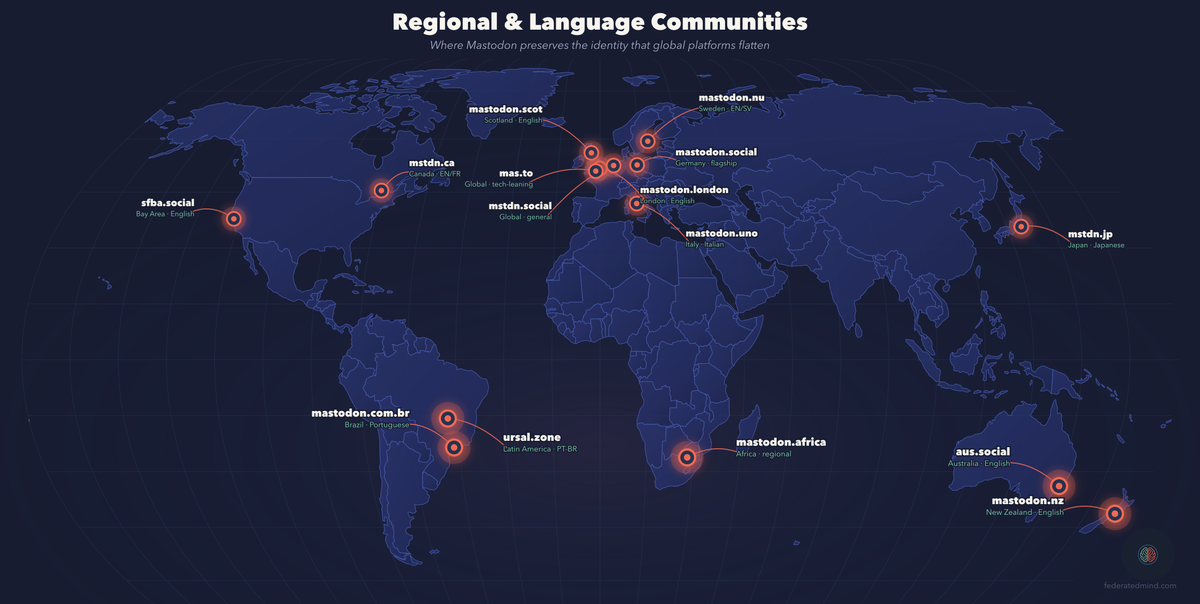
Open sfba.social on a Sunday morning and you'll find someone posting a photo of the line outside Arizmendi — no caption. No "worth the wait" or "best bakery in the city"; just the queue, just the morning light on the sidewalk. Three posts down, a link: "Bay to Breakers registration just opened." No explanation of what it is, when it happens, or why you'd want to spend a Sunday in May running from the Embarcadero to Ocean Beach as one-thirteenth of a centipede. The people reading already know. That's who the post is for.
This is what specificity looks like when it works. Not as a moderation category or a server description, but as a lived property of a timeline: the accumulated effect of a community small enough and focused enough that shared context can be assumed.
Part 1 of this series established the structural case: Mastodon is a protocol connecting communities, not a product with a unified user base. This post is what that structure feels like from the inside, through the regional and language instances organized around place and the craft communities organized around shared work. The difference between them and a general instance isn't primarily about rules. It's about what you can assume when you write.
The local timeline changes what you write
The local timeline on mastodon.social with its hundreds of thousands of users is, in practice, unreadable. No single person can follow the whole thing. Most people ignore it and build their experience entirely through follows and hashtag subscriptions: accounts and topics they've deliberately chosen. On mastodon.scot with a few thousand members, the local timeline is the community. You can actually read it.
That readability changes the posting incentive in a specific way: when you know your audience is a few thousand people who share a geography, you write for that audience. Posts on mastodon.scot assume Scottish political context without supplying it. They reference specific areas of specific cities (the Southside, Leith, Byres Road) without explaining what or where they are. A post about independence referendum discourse doesn't begin by establishing that Scotland is considering independence, or what the SNP (Scottish National Party) is, or why the constitutional question is still live. The reader is assumed to know. This is exactly what "shared context" means in practice: not an abstract property of the community, but a daily reduction in how much scaffolding each post has to carry.
The effect compounds over time. A community whose members assume shared context produces posts that are more specific. More specific posts attract more people who want exactly that specificity. The community becomes denser and better at its core thing, not through algorithmic ranking but through the simpler mechanism of shared assumptions.
The same structural logic holds for mastodon.london, where "London" functions as a unit of identity rather than a location tag. Posts there assume familiarity with specific neighborhoods, the tube, the particular texture of London civic life.
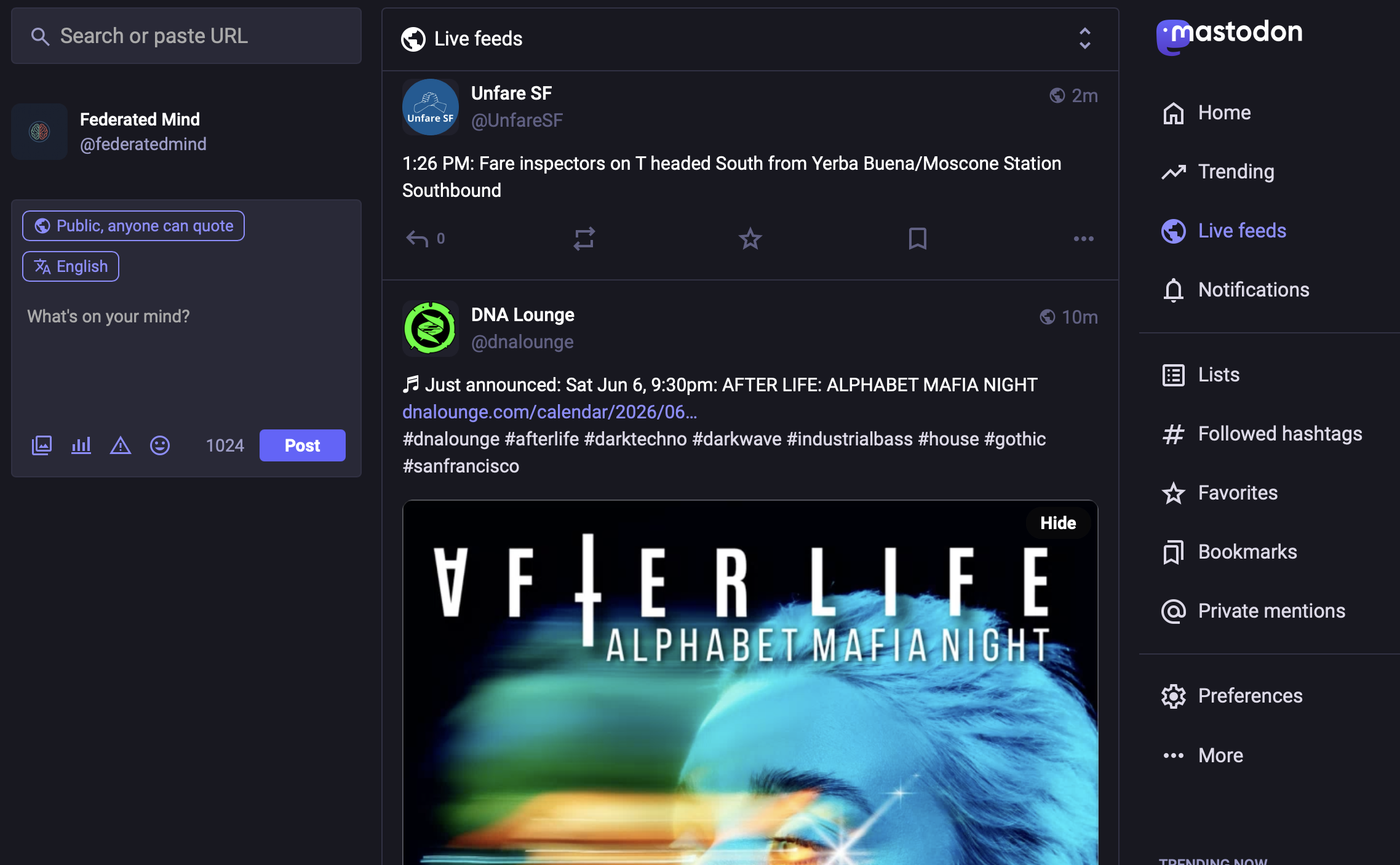
The weekday timeline on sfba.social runs on a different register. @UnfareSF posts "1:26 PM: Fare inspectors on T headed South from Yerba Buena/Moscone Station Southbound." No explanation of what the T line is, no context about why you might care. You either ride Muni or this post isn't for you. The shared context here isn't just identity; it's real-time civic intelligence posted on infrastructure that doesn't require a platform to decide it's worth surfacing. The Bay Area angle adds its own irony: this is where the technical and policy decisions about centralized social platforms get made, and a regional community on federated infrastructure makes the alternative visible in a way that's hard to dismiss.
When language is the shared context
Regional instances organize around geography. Language instances organize around something deeper. Language isn't just a filter on content; it carries conversational norms, humor conventions, approaches to disagreement, and what counts as an appropriate post length.
mstdn.jp is one of the longest-running major Mastodon instances, and the Japanese social media context it operates in differs from Anglophone defaults in ways that aren't obvious from the outside. Japanese online communication has historically favored more detailed, carefully contextual posts than the quick-take style that dominated Twitter's Anglophone culture — precise attribution, layered meaning, and a preference for supplying context rather than assuming the reader will fill it in. The fandom thread running through much of Japanese internet culture produces a different posting cadence: detailed episode reactions, collaborative speculation threads, artwork sharing with careful attribution. None of this translates into a timeline designed around the assumption that posts should be short and punchy. mstdn.jp doesn't impose these norms; it accommodates them by being a space where the ambient community already operates that way. A post that would read as unusual length or unusual care on mastodon.social reads as entirely normal there.
The subtler difference is in how disagreement works. Cross-cultural communication research consistently documents a tendency toward indirection and face-saving in Japanese discourse: corrections that soften the assertion, pushback framed as questions rather than counter-claims, replies that acknowledge multiple perspectives before landing a point. None of this is a mstdn.jp rule. But those cultural defaults tend to travel with a community that shares a first language and its conversational norms, and a timeline organized around Japanese speakers is where you'd expect them to show up.
mastodon.uno does the same for Italian conversation, at a different cultural register. Italian political life (the party system, the regional dynamics, the recent history of coalition governments) is specific enough that references to it don't translate cleanly into a multilingual timeline. On mastodon.uno, a post about current political developments drops those references without setup because the audience already carries the relevant context. The humor is different too: Italian internet culture has its own comedic registers around bureaucracy, football, and regional identity that land precisely because the audience shares the cultural substrate they depend on.
mstdn.ca's bilingualism is structurally distinct from both. Rather than organizing around one language as primary, it runs as a genuinely bilingual instance: English and French activity coexist in the local timeline without either being treated as the default. In practice, this means scrolling from an EN post about Canadian tech news directly into a FR post about Québécois cultural policy, with no translation layer and no expectation that you understand both. Some users code-switch between conversations; some post exclusively in one language and follow across the language divide through federation. No American-headquartered platform has had an incentive to model national bilingualism well. mstdn.ca doesn't do it perfectly, but the structure reflects what a national-scale Canadian community actually contains, which is more than any single-language default represents.
The language point generalizes: the fediverse hasn't flattened these differences. Somewhat unusually for a social network, it has preserved them.
What you can say on a craft instance
Where regional and language instances organize around identity, craft instances organize around what people do. The dynamics differ: no shared geography, often no shared first language. But the structural mechanism is the same. A community with shared technical vocabulary creates a local timeline that assumes it, and that assumption changes what gets written.
Fosstodon's local timeline on any given afternoon runs through a recognizable cadence. CLI (command-line interface) tool release announcements posted by the author. Self-hosted alternatives hitting their first stable versions. Self-hosting migration posts: "Finally moved off [cloud service] to [self-hosted alternative] running on a $6 VPS (virtual private server), if anyone wants the Ansible playbook." Terminal setup screenshots that generate real technical discussion, with replies on the colorscheme, the font, the specific shell plugin. The occasional sharp governance debate about open-source licensing that reads as esoteric on a general instance but lands with full context here.
These posts are unremarkable on Fosstodon because the community is organized around exactly the concerns that produce them. The person releasing the CLI tool can announce v2.3.1 and expect part of their audience to have actually used v2.3.0. Debates about FOSS (free and open-source software) philosophy assume a reader who knows why license choice matters. The conversational floor is higher, which means every post carries more information.
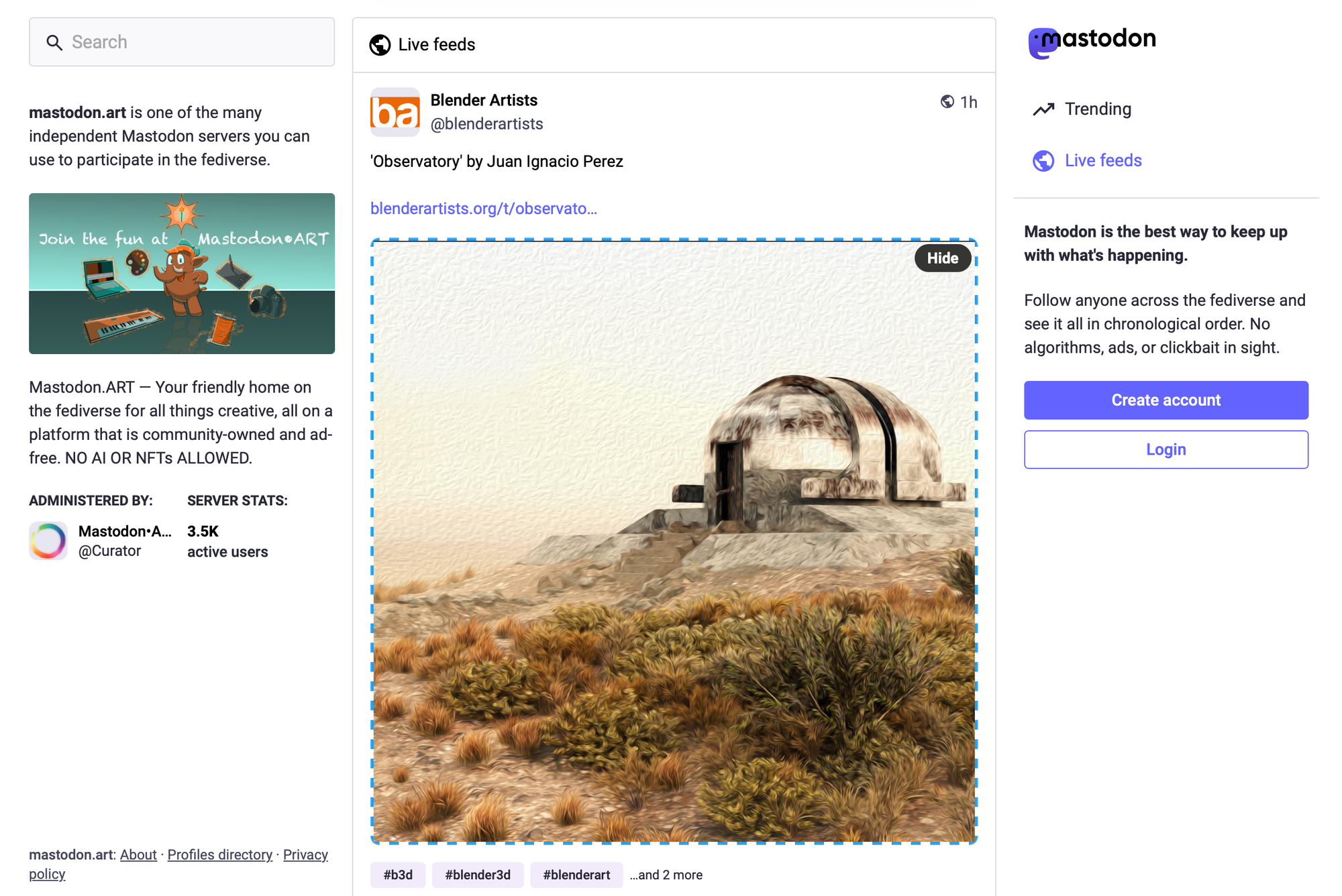
mastodon.art's local timeline works from a different set of assumptions. The community is organized around making things by hand (illustration, digital painting, photography, concept art), and the local timeline reflects that. Process shots appear mid-work, posted not as finished content but as thinking out loud: here's where this piece is, here's what I'm trying to solve. Other artists reply with specific technical responses, not just "this is beautiful" but "the light source here is creating an issue with the secondary shadows" or "what brush are you using for that texture in the background?" When a new artist posts their first work on mastodon.art, the response tends to be engaged and specific rather than generically encouraging. People who do the same work recognize what they're looking at and respond to it as such.
The AI content ban on mastodon.art matters here not primarily as a moderation policy but as a community definition. The members who chose mastodon.art after the generative AI wave of 2022 and 2023 chose it specifically because it protected hand-made work. The ban isn't an obstacle to posting; it's a description of who the community is for. An illustrator posting there knows that the person replying to their work is also making things by hand: the visual vocabulary, the aesthetic concerns, the technical judgments all come from the same practice. That shared basis is what makes the specific, engaged response possible.
infosec.exchange has its own register: technical, precise, and skeptical in a way that reflects the professional culture of security research. Posts there coordinate vulnerability disclosure with the careful framing that public research requires: how much detail to share, when, and in what form. When a CVE (Common Vulnerabilities and Exposures, the standardized reference for publicly known security flaws) drops, the timeline moves fast. Summary posts appear within minutes, clarifications follow, the thread of technical analysis plays out in public and in real time. The community's precision norms mean vague or overclaiming security statements get pushback, not hostile but correction in the register of people who think carefully about what can and can't be asserted.
On a general instance, a post about a security vulnerability has to carry its own context: what the class of flaw is, why it matters, who should care. On infosec.exchange, that context is already in the room. The post can start further into the argument.
The specificity cost
A craft or regional community lifts the conversational floor. It also creates friction when you post off-topic within it.
An illustrator on mastodon.art who wants to talk about their local political situation, their programming side projects, or their cooking is posting into a community organized around something else. The community won't penalize them (these aren't hostile places), but the local timeline won't serve that content well either. The practical response is often to follow accounts from other communities through federation, which works reasonably well for staying connected across interests. Running multiple accounts, each scoped to a different dimension of your life, is more normalized here than on centralized platforms — alts for specific topics, backup accounts, work and personal splits — but it's still real overhead, and most people don't maintain more than one or two.
This tradeoff isn't a flaw. It's the shape of what specificity costs. A neighborhood that knows everyone and shares a common concern is valuable precisely because it isn't trying to be everything. Federation means you can still follow anyone anywhere, so depth and breadth aren't mutually exclusive, just separately managed. That's more work than having an algorithm do it invisibly, and more honest about what the choices actually are.
What you're actually choosing between
General instances are on-ramps. They're built to be legible to anyone who shows up, which means they're calibrated for no one in particular. The communities in this post work differently: they've accumulated shared context over time, and that accumulated context is what changes what you can write and what comes back.
That's not an argument against general instances. Part 1 covers why they're useful starting points, and they are. It's an argument for knowing what you're looking for once you've had a chance to look. The question when choosing or reconsidering isn't "which server has better features?" (they don't differ much technically) but whether the community's ambient assumptions already match what you're trying to say. A general instance gives you the protocol. A specific community gives you the room that already knows how to receive it.
Want a shortcut to your first Mastodon setup? The Fediverse Quick-Start Checklist is a free PDF that walks through the key decisions (instance choice, app selection, profile setup, and first follows) in a single reference.
Further reading
Instances in this post
- sfba.social — San Francisco Bay Area regional instance
- mastodon.scot — Scottish community instance
- mastodon.london — London-focused regional instance
- mstdn.jp — One of the oldest major Japanese-language Mastodon instances
- mastodon.uno — Italian-language instance
- mstdn.ca — Bilingual English/French Canadian instance
- Fosstodon — Free and open-source software community
- mastodon.art — Art and illustration community; no AI-generated content
- infosec.exchange — Information security community
Finding your instance
- Mastodon server browser — searchable by language, topic, and region; maintained by the Mastodon project
Part 3 of this mini-series takes on governance: AI policy, moderation defederation, and what Truth Social illustrates about what happens when a community takes Mastodon's code and removes the protocol that makes it what it is.