Year of the Cockroach
Meta suspended a San Francisco queer bar's Instagram. India ordered GitHub to delete a messaging app's source code. US prosecutors charged a man over a phone running GrapheneOS. Each time the target moves further down the stack, fewer people can route around it.
The Stud has been called the oldest queer bar in San Francisco. It has been open since 1966, on Folsom Street in South of Market, the district known locally as SoMa. The bar is owned and run by a collective, and describes itself as the first worker-owned cooperative nightclub in the United States.
One of its annual windfalls is Dore Alley (a leather and fetish street fair that has drawn people to Folsom Street since 1985), which cushions the bar through slower months. Days before this year's fair, Meta, which owns Instagram, Facebook, Threads and WhatsApp, warned the bar that its Instagram account was about to be suspended.
The account had 32,000 followers. It held the bar's marketing, its ticketing, and its working communications with performers and clients. Someone had gone through months-old posts advertising parties that had already happened and reported them as human trafficking. The reports were false, but Meta acted on them anyway.
The Stud filed an appeal immediately. On Friday, Honey Mahogany, one of the bar's owners, posted a video to a personal Instagram account calling on Meta to reverse the decision. Mahogany is a drag performer and the director of San Francisco's Office of Transgender Initiatives. More than 400 comments piled up beneath the video, repeating the demand. The appeal failed anyway. On Saturday afternoon, the day before the fair, the page went dark.
What it took to get the account back
Rachel Ryan, another co-owner and the bar's general manager, also pressed the case publicly. In an interview with Mission Local (a local San Francisco newspaper), Ryan declined to accuse the company of nefarious intent, and said Meta had the right to police its own platform. What alarmed Ryan was the mechanism: "some random person sitting on their computer, digging through archives of our events, can have the power to flag us with serious allegations and enact this very un-American censorship with just a couple of clicks."
State Senator Scott Wiener posted on X that Meta had shut the account down "on Dore Alley weekend no less" over "targeted harassment complaints by right wing extremists," and told the company to reverse the ban immediately. San Francisco District 6 Supervisor Matt Dorsey did the same, tagging Meta and asking it not to "let homophobic harassers victimize one of San Francisco's oldest and most beloved LGBTQ+ venues."
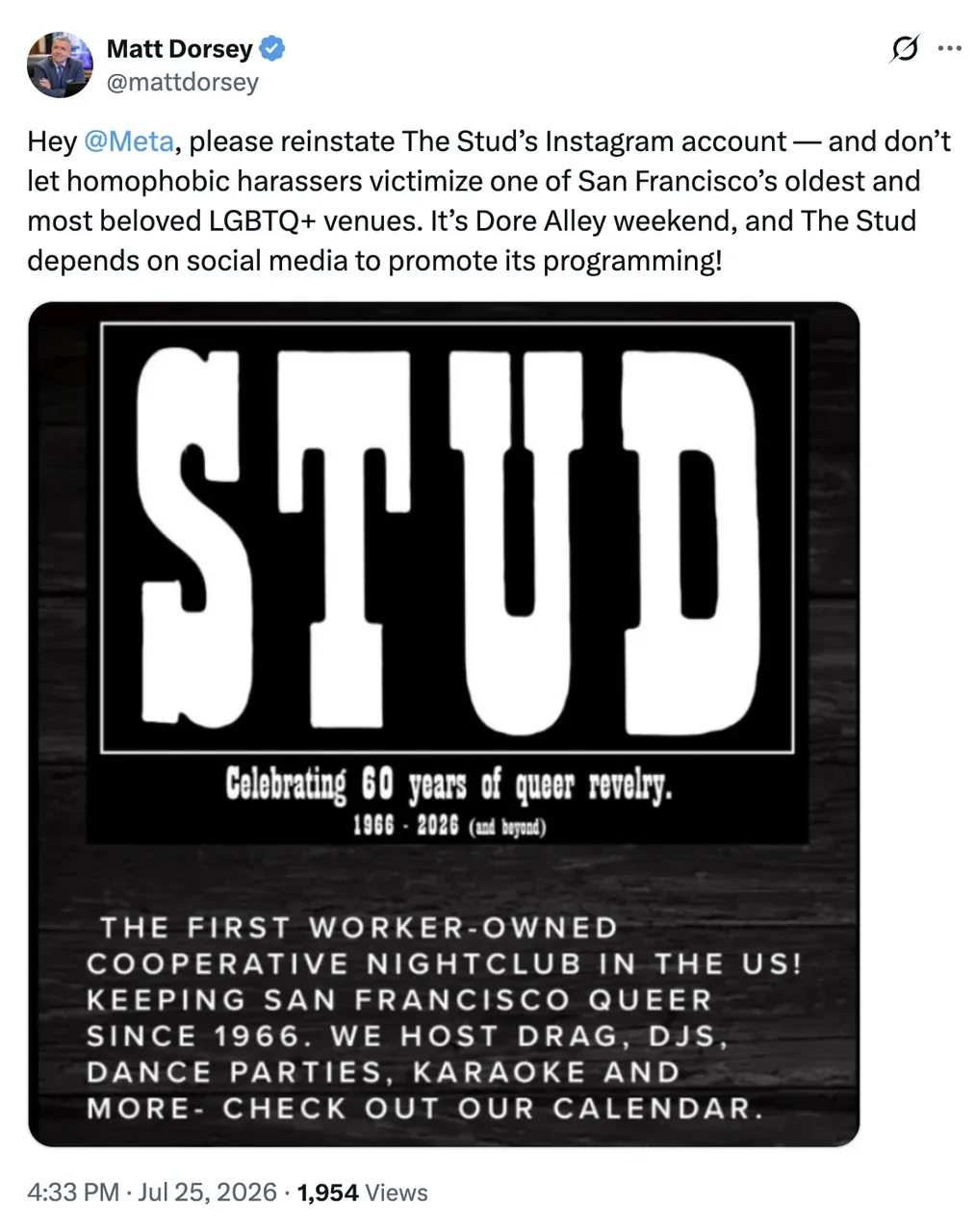
At around 6:40 that evening, the account came back with its followers intact. A Meta spokesperson, Dave Arnold, confirmed the restoration and gave no explanation for the suspension.
A pattern emerging from a policy failure
Three months earlier, Meta's Oversight Board overturned another removal. The Board operates independently but is funded through a trust Meta created, and its rulings on individual cases are binding on the company while its wider policy recommendations are not. An Instagram account devoted to lesbian visibility had posted a carousel of photographs of older couples, with text about how their relationships had been dismissed for decades as friendships. One image carried the phrase toda sapatão é uma potência, roughly "every dyke is a force." Meta's systems read the reclaimed slur as hate speech and pulled the post.
The Board's ruling named two failures. Meta keeps mishandling slurs used self-referentially, and Meta keeps judging individual images in a carousel without the context of the images around them. The removed image did not even contain the flagged word.
Meta restored the post only after the Board selected the case for review. In its statement the company agreed the carousel had honored "the lesbian love stories of older generations of women" and that the term appeared in a reclaimed, positive context.
These enforcement mistakes sit on top of a rulebook the company rewrote on 7 January 2025. That same day, Meta ended its third-party fact-checking program and announced it was moving its US content review team to Texas. It also revised what it now calls its Hateful Conduct policy.
The revision added an explicit allowance for "allegations of mental illness or abnormality when based on gender or sexual orientation, given political and religious discourse about transgenderism and homosexuality." It permitted content arguing for exclusion by sex or gender from bathrooms, sports leagues, specific schools, and military, law enforcement and teaching jobs. It also deleted prohibitions that had stood for years: the ban on comparing people to inanimate objects, which had specifically covered calling transgender and non-binary people "it"; the ban on saying a protected group "shouldn't exist"; and the ban on self-declared intolerance, which the old policy spelled out as homophobic, islamophobic, or racist.
GLAAD, an LGBTQ media advocacy group that scores the major platforms each year in its Social Media Safety Index, called the rewrite a wholesale abandonment of content moderation norms. Its president, Sarah Kate Ellis, said the changes gave "the green light for people to target LGBTQ people, women, immigrants, and other marginalized groups." The organization describes "transgenderism" as a neologism that recasts being transgender as an ideology rather than a characteristic of a person. Meta wrote it into the sentence governing what may be said about trans users. The Oversight Board recommended the company remove it, and a year later Meta's compliance report says it is still assessing feasibility.
Abusive language aimed at entire communities or movements is not new. If "transgenderism" sounds like an invective, that's because it is.
So is calling someone a cockroach.
A meme that turned into a movement
On 15 May 2026, the Chief Justice of India, Surya Kant, was hearing a petition about how the Delhi High Court designates senior advocates. From the bench, he said that young people who fail to find jobs turn to social media, journalism and right-to-information activism to attack the system. He called them cockroaches and parasites of society.
He clarified the next day that a section of the media had misquoted him, that he had meant only those entering professions such as law with fake degrees, and that India's young people were the pillars of a developed India. But that same day, a political communications strategist named Abhijeet Dipke registered the insult as a party name: the Cockroach Janata Party.
The Cockroach Janata Party (CJP) began as a parody of the Bharatiya Janata Party (BJP), India's ruling party since 2014 under Prime Minister Narendra Modi. It was meant to be a satirical account with a logo and a grievance. It called itself "a political front of the youth, by the youth, for the youth" and the "Voice of the Lazy and Unemployed." Its website carried a footnote confirming the whole thing was satire, a form to join, and a manifesto. The manifesto asked for an end to post-retirement appointments to the Rajya Sabha, the upper house of India's parliament, for retiring chief justices. It also wanted fifty percent reservation for women in Parliament without enlarging the house, and a twenty-year bar on politicians who defect to another party.
But within weeks it had stopped being a joke: the manifesto and the messaging had resonated with the frustrated youth of India. Five days after Dipke registered the name, the party said more than 600,000 people had signed up.
The initial grievance about being called a cockroach left an impression and quickly found engagement on social media. But a second grievance was already in motion, and the party became its vehicle.
The NEET legacy
NEET, the National Eligibility cum Entrance Test, is the single entrance examination for medical school across India. Around 2.2 million students took it on 3 May 2026. Allegations that the paper had leaked surfaced within days, and on 12 May the National Testing Agency cancelled the exam and handed the investigation to the Central Bureau of Investigation.
This was not the first such incident. Similar allegations in 2024 brought opposition demands for the resignation of the education minister, Dharmendra Pradhan. He declined, saying no concrete evidence of rigging, corruption or a leak had come to light. Parliament passed a law against paper leaks that year, the Public Examinations (Prevention of Unfair Means) Act. The leaks continued.
The re-examination on 21 June was held under guard, with question papers flown to centers on Indian Air Force aircraft. Results followed on 16 July, and candidates raised fresh concerns about score discrepancies. On 20 July thousands marched on Parliament, were stopped by barricades, and some were detained.
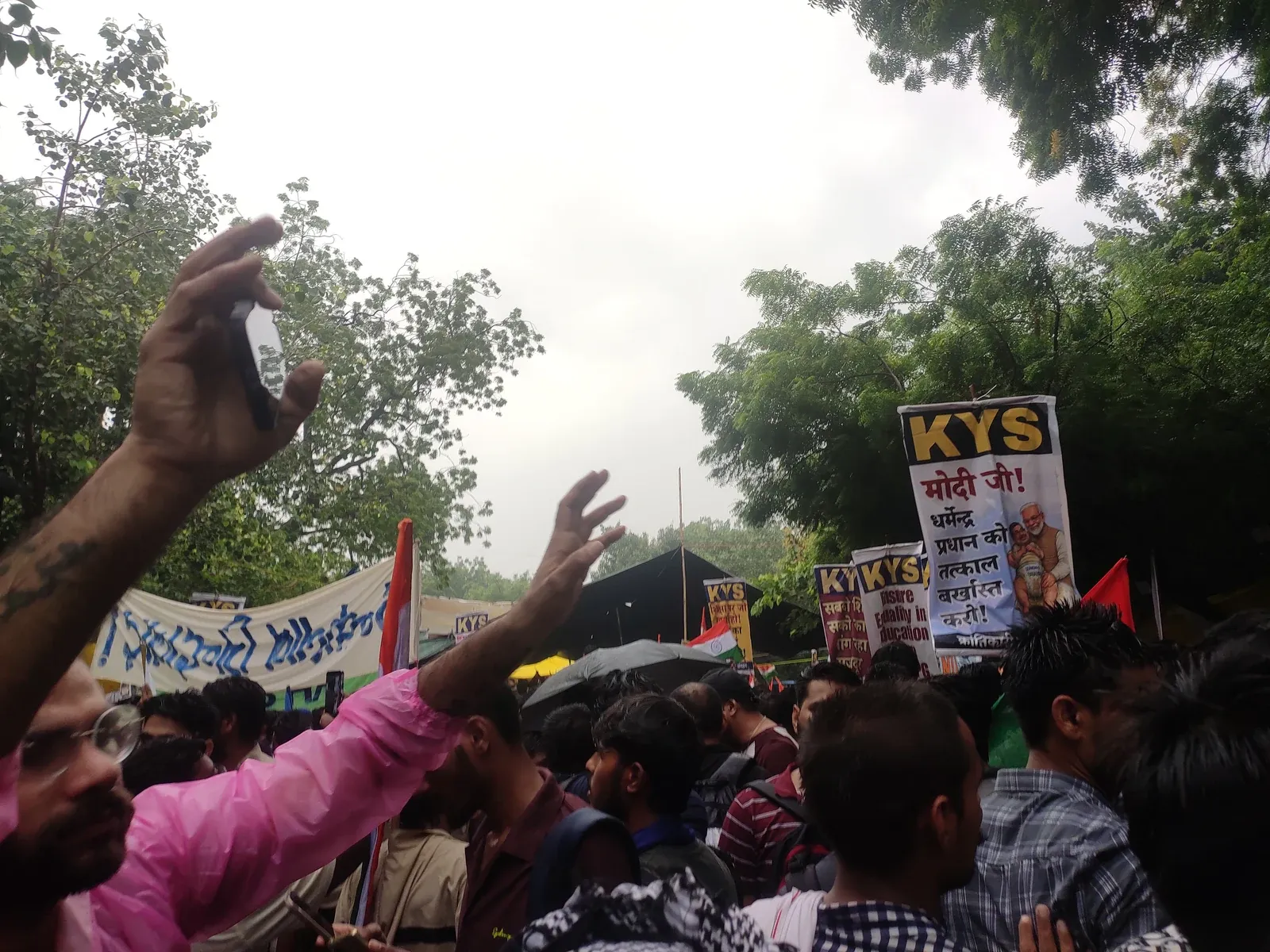
For students who had spent years and their families' savings preparing, the leaks meant the competition had been decided somewhere else.
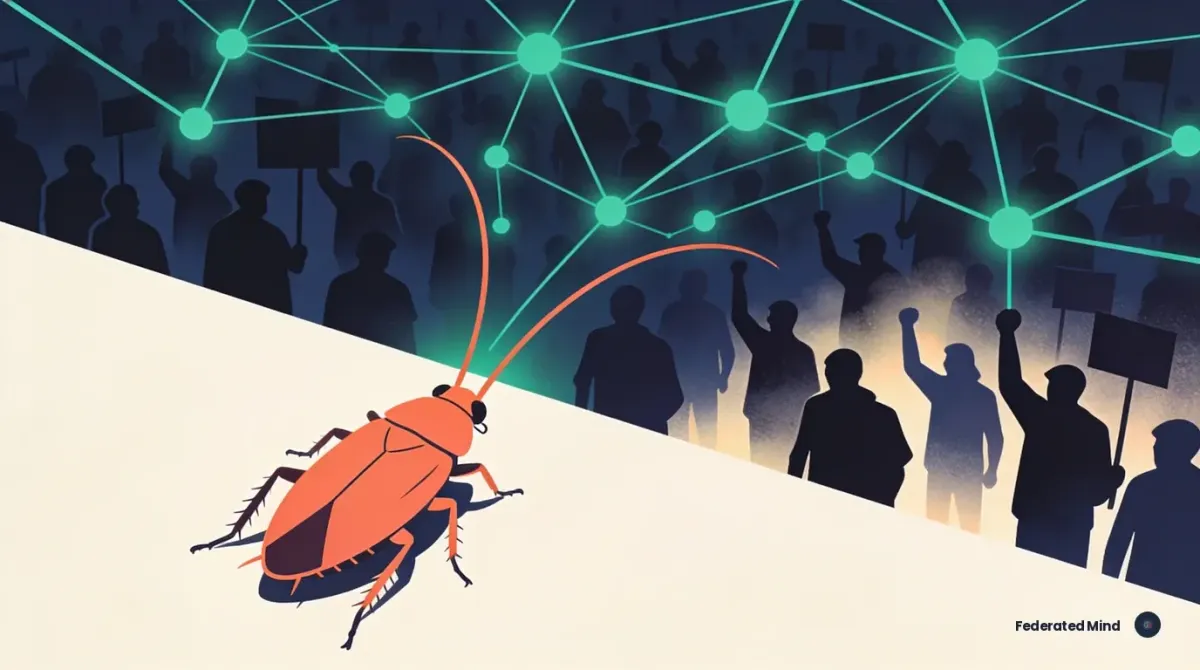
Young people put on cockroach masks and filled Jantar Mantar, the ground in New Delhi where Indians have gone to protest for generations. The party's Instagram following passed twenty million, more than the BJP's. What began as satire about being called cockroaches became one of the largest protest movements the country had seen in more than a decade. Its demands widened from examinations to jobs, to the economy, to the sense that an entire generation had been written off.
What the state started suppressing
The first thing to go was the account. On 21 May, five days after the party was created, X withheld the CJP's account inside India, telling users it had acted in response to a legal demand. "As expected," Dipke posted from his personal account, alongside a screenshot of the block notice. A senior government official told the Indian Express the decision followed national security concerns raised by the Intelligence Bureau. Dipke called it an own goal. The party's Instagram account, then at 13.4 million followers, stayed up, and the movement opened a new account on X as @Cockroachisback.
Two months later, with the protests filling New Delhi, the network was next. On 23 July, authorities asked telecom companies to disable mobile data around the demonstration. Governments reach for that lever often. #KeepItOn, a coalition of civil society groups hosted by the digital rights organization Access Now, counted 313 internet shutdowns across 52 countries in 2025, the highest annual total it has recorded. Cutting data does not stop a crowd that is already assembled. It stops the crowd from organizing.
So the protesters stopped using the internet. They downloaded Bitchat and Briar, messaging apps that pass messages phone to phone over Bluetooth without touching a tower or a server. Between 17 and 23 July, India accounted for about 85% of Bitchat's global downloads, against roughly 1% over the previous thirty days. On 19 July alone, downloads jumped thirty-two-fold over the previous day. By Thursday, daily active users in India passed 330,000, the highest the app had ever recorded there.
That same day, India's Cyber Crime Coordination Centre, an arm of the Home Ministry, sent GitHub an order to disable three repositories: the main Bitchat project, its Android build, and its Android release files. GitHub was given three hours to comply, and the notice was timestamped 11:16 p.m., leaving no practical window to contest it. It cited Section 79(3)(b) of the Information Technology Act and warned of lost safe harbor protection and criminal prosecution.
The notice identifies no illegal post, no unlawful message, no specific piece of content. Its objection is to how the software works. Bitchat, it says, lets people communicate during network restrictions and internet shutdowns, which allows them to circumvent lawful restrictions and hampers lawful interception, attribution, and traceability.
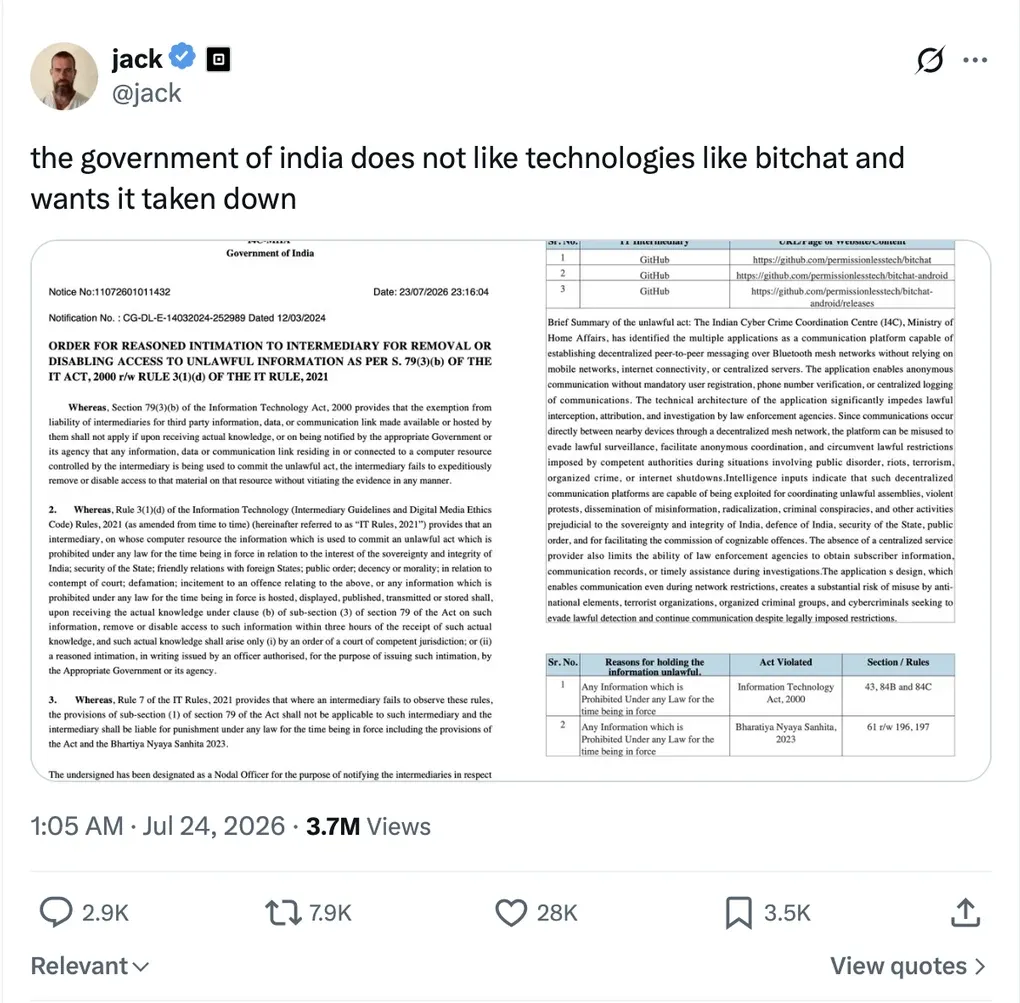
Jack Dorsey, whose company backs the app, published the notice on X on 24 July: "the government of india (sic) does not like technologies like bitchat and wants it taken down."
The Internet Freedom Foundation, a digital rights group in New Delhi, put it precisely: "deleting a repository does not delete the application from any phone that carries it, and the mesh keeps functioning without servers. What the takedown actually prevents is scrutiny of the underlying code."
Every phone that had already installed Bitchat kept it. Every one of those phones could still reach every other. Removing the repository would have hidden the source from the researchers who audit it, while leaving the running network untouched.
Mishi Choudhary founded the Software Freedom Law Center, India, a digital rights group known as SFLC.in. She noted that until 2021 the government generally used a different provision, and a separate set of blocking rules, when it wanted something removed nationwide. The sections cited here, she said, do not clearly authorize removing an entire software project because of its design rather than for any specific illegal content. Raman Chima of the Association for Progressive Communications drew out the implication: the government is "not just targeting the designated service provider, but they're trying to say that open source development of this type of product … should not occur."
Namrata Maheshwari of Access Now described what blocking offline messaging during a shutdown produces: a communication blackout.
GitHub would not confirm receiving the document, and pointed to the public archive where it publishes the government takedown requests it acts on. The archive lists no request about Bitchat. The three repositories are still live.
How a mesh works
A shutdown is not one app going down. Carriers cut mobile data across a district or a state, and every service that needs the internet stops at once: maps, payments, ride-hailing, the messaging apps people organize in. Phones still show signal bars, and nothing loads.
Bitchat uses Bluetooth Low Energy, the same short-range radio that connects headphones to a phone. Instead of sending a message to a server that forwards it to a recipient, each phone relays messages for the phones near it. A message hops from device to device until it reaches its destination, or until it runs out of neighbors. None of that traffic touches a carrier, which is why cutting the carrier does not touch it.
Nothing in that path belongs to anyone. There is no tower to disable, no company to serve with an order, no account to suspend, because there is no account. A phone joins the mesh by being present and running the software. An internet shutdown leaves it running, and with no server in the middle, the architecture is the only thing a takedown notice can object to.
Bluetooth range is measured in tens of meters. A mesh works when people are packed together, which is the condition at a protest and not the condition of a country. It coordinates a square when the network is down, and it is no substitute for the internet.
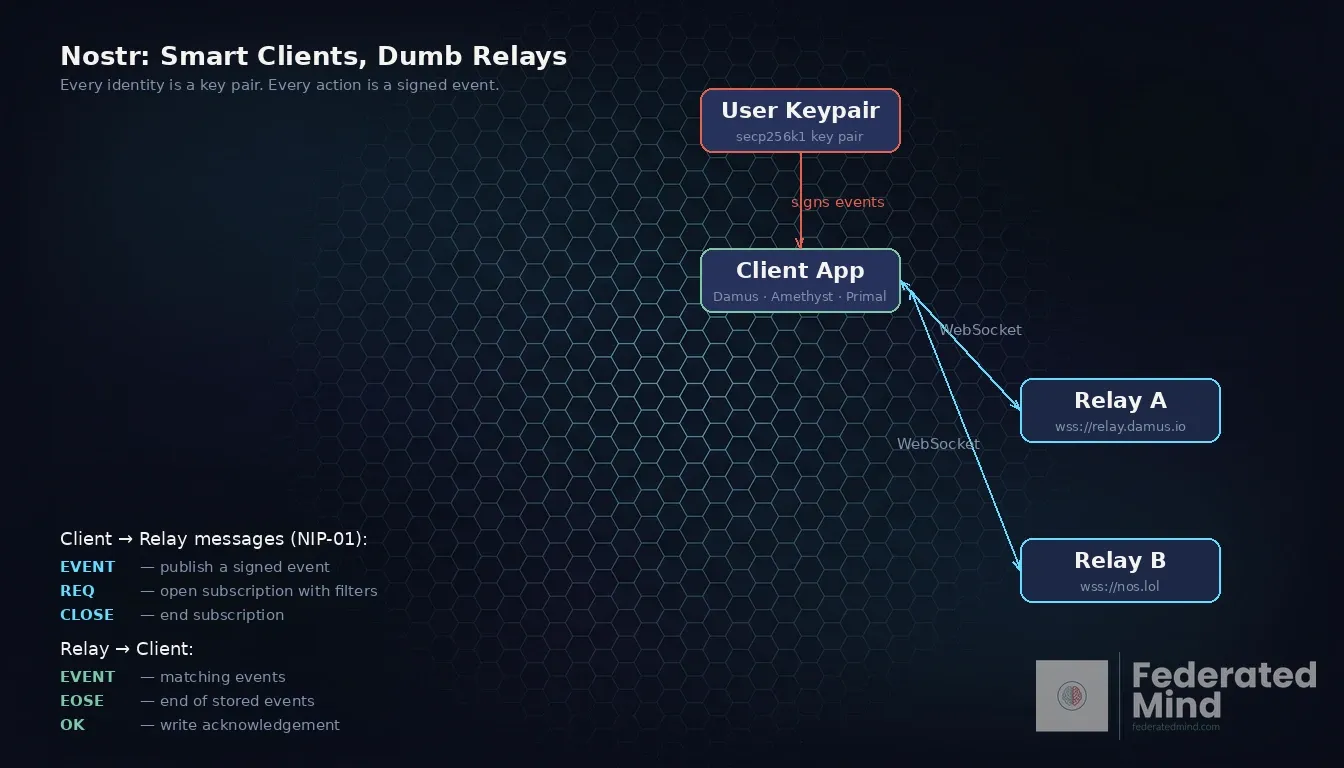
Nostr covers the distance the mesh cannot. It identifies you by a cryptographic keypair rather than a username on a company's servers, and your posts go to relays, independent servers that anyone can run. Clients read from many relays at once. Blocking one relay removes you from that relay and from nowhere else. Your identity is the key you hold, so a relay cannot take your audience with it when it disappears. There is no chokepoint, by design. Our post from the "Federation Across Networks" series, Nostr and the Protocol Bridges, covers the architecture in full, including the relay ecosystem and the bridges out to ActivityPub and AT Protocol.
The resignation
The government spent the last week of July trying to hold the line. The National Testing Agency, which runs the exam, terminated 47 officials on 24 July, on top of its former director general. The Union Cabinet approved a bill raising the minimum sentence for a paper leak to five years. Government sources said the same day that there was no question of the education minister going. "Resigning and running away from responsibility will be the easiest thing to do," they said. "People have given us the mandate, and we will deliver."
On 25 July 2026, Pradhan resigned. "I have sent my resignation to Prime Minister Narendra Modi," he said. The CJP called off its nationwide protests with immediate effect. Modi announced a task force to reform the examination system.
The cockroaches won.
But what if the state had persisted and raised the stakes? What if they had outlawed the devices running specific apps? Or entire operating systems? That is the chilling prospect these next cases raise.
When the tool becomes the evidence
First, some context: people are leaving the large platforms deliberately, or at least they are trying to. There is a movement to de-Amazon the Kindle. On 20 May 2026, Amazon ended Kindle Store support for every Kindle and Fire tablet released in 2012 or earlier, so those devices can no longer buy or download books. Owners have responded by jailbreaking them and installing KOReader, a free and open-source reader, to keep the hardware useful.
The DeGoogle movement has spent years documenting how to strip Google services out of a phone. In January 2026 the exit got narrower: Apple signed a multi-year deal, reported at around a billion dollars a year, to put Google's Gemini behind a rebuilt Siri. Switching between the two mobile ecosystems no longer changes who supplies the assistant.
One way out is to replace the operating system itself. GrapheneOS is a hardened version of Android, open source and auditable, maintained by a Canadian nonprofit on donations and installed free from its own website.
It runs only on Google Pixel hardware, because those devices offer the security foundation it needs. Pixels running it are among the few consumer phones that reliably resist the forensic unlocking tools that police forces buy from vendors such as Cellebrite.
In November 2025, that resistance became the story in France. A confidential police memo dated 7 November complained that investigators could not get into phones running GrapheneOS. On 19 November, Le Parisien built an article on the memo and ran it under a headline calling Pixels with GrapheneOS the secret weapon drug traffickers use to protect their data from police. A suspect had been arrested with such a phone, and the phone had erased itself when police tried to unlock it. GrapheneOS supports a duress code, a second PIN that wipes the device when entered, built for people facing coercion. The suspect had entered it himself.
Joanna Brousse, the deputy prosecutor in Paris who heads cybercrime, gave an interview. Asked about the software, she raised the possibility of prosecuting the publishers if links were found to a criminal organization, or to someone who would not cooperate. She added that "nothing is unbreakable."
Nobody in France was charged for running the operating system. The pressure landed on the people who make it, and it worked. Within days GrapheneOS announced it was removing its infrastructure from the country, ending its relationship with its French host and moving its discussion and social servers to Toronto and its website infrastructure to a German provider. The project said France was not a safe country for open source privacy projects.
Nine months before that memo, a man named Sam Tunick landed at Hartsfield-Jackson in Atlanta on a flight from the Dominican Republic. Agents had already circulated his name and photograph internally, describing him as under investigation for suspected terrorism activity over an alleged association with the movement opposing Cop City, the police training facility built outside the city. He was pulled into secondary screening and questioned. Agents asked repeatedly for his phone's passcode and told him the device would be seized otherwise. When he entered a code, the screen went blank, flashed, and the phone restarted. The data was gone.
Tunick has been charged under a federal statute covering destruction of property to prevent its seizure. His lawyers have filed a motion arguing the interrogation used an accusation of child sexual abuse material as a pretext to investigate his protest ties, that he asked for a lawyer four times and was refused each time, and that agents produced no warrant and never read him his rights. Those are allegations in a filing, not findings. A Customs and Border Protection officer, Larry Findley, testified that the inspection was routine. A judge is not expected to rule on the motion until late October.
This may be the first time the statute has been pointed at an operating system. Christophe Boutry, a surveillance researcher, called the prosecution concerning for the message it sends, that the software is criminal by default. Bill Buddington, a senior staff technologist at the Electronic Frontier Foundation, said he had not seen a comparable case. Boutry also noted that in Catalonia, police have profiled people carrying Pixel phones on the assumption that the device implies GrapheneOS, and GrapheneOS implies a dealer.
A modern iPhone encrypts its contents to a standard that obstructs investigators in much the same way, and nobody suggests that buying one demonstrates intent to conceal. The encryption is comparably strong in both cases but what's different here is who is shipping it.
The chokepoint keeps moving down
So, what do a bar in San Francisco, a protest in New Delhi, and an operating system have in common?
A bar loses its account because a stranger filed a false report, and gets it back because two elected officials intervened. A movement loses its account, opens another, and keeps going, so the state cuts the mobile network, and when people route around the network the state tries to delete the source code. A nonprofit builds an operating system that resists forensic extraction, and finds its publishers threatened in one country and a user prosecuted in another.
Account, then network, then source code, then the operating system itself. Each step down the stack, what gets squeezed is harder to replace and further from anything an ordinary person can appeal. You can email Meta about an account. Contesting a federal charge over what your phone did takes a lawyer, a suppression motion, and months of waiting for a ruling.
The other pattern is who gets relief. The Stud had a state senator, the Brazilian account had an oversight board and the CJP had twenty million people. Every reversal here came from leverage, applied publicly, by someone with enough standing to be heard. That is a system of exceptions rather than rights, and exceptions are granted to the visible.
What can we do about all of this?
None of what we stated here argues for abandoning the platforms where people are. The CJP reached twenty million followers on Instagram, and that reach is how thousands of them ended up at Jantar Mantar. What forced the resignation was the sit-in and the march on Parliament.
Use them for reach. Do not let the layer you cannot afford to lose sit inside somebody else's account. The Stud's marketing lived on Instagram, which is a reasonable place for marketing. Its ticketing and its performer communications lived there too, so one suspension took all three, days before the fair. A mailing list you own, a domain you control, an identity that is a key rather than a username: these are unglamorous, and they are the difference between losing an audience and losing a channel.
The second thing costs money. GrapheneOS runs on donations, and it moved its servers out of a G7 country in a week because the legal exposure was unacceptable. The Internet Freedom Foundation, SFLC.in, Access Now, and the EFF are the reason there is informed legal commentary about a midnight takedown order at all.
Many of the people moderated off the large platforms land on the fediverse, in the ATmosphere, or on Nostr. The fediverse is the network of independently operated servers that federate with one another, Mastodon among them; the ATmosphere is the set of apps built on the AT Protocol behind Bluesky. Many of the platforms running on these protocols are maintained on volunteer time, with operators paying hosting bills out of their own pockets. Infrastructure that nobody owns still has to be paid for by somebody.
Adopting these tools can draw attention on its own, as GrapheneOS users found in Paris and Atlanta. A tool used only by people with something to hide marks its users. Encryption that only journalists and dissidents use identifies journalists and dissidents. Encryption that everyone uses protects them, which is an argument for more people using it rather than fewer.
So the biggest takeaway is this: support these platforms, the people building them, the people using them. If you are able to code, then contribute to the codebase. If you're able to fund these projects, go to the project pages, the instance pages, and support them using OpenCollective, Patreon, Ko-Fi, or other modes of payment. Support local chapters or similar versions of organizations like the EFF, Access Now, SFLC.in, and the Internet Freedom Foundation.
If you're able to influence decisions as a policy maker, speak up for these platforms. If you're a community organizer, help spread the word. And if all else fails, then band together and organize to influence your policy makers. Form your own CJP.
The offhand cockroach remark was meant as an insult and a dismissal. But the thing about cockroaches is that they are famously resilient, capable of outlasting just about anything.
Sources and further reading
The Stud and Meta
- After outcry, Meta reverses suspension of SoMa queer bar's Instagram page — Brandon Pho, Mission Local, 25 July 2026. The reporting this section is built on.
- Meta mishandled lesbian content on Instagram — Christopher Wiggins, The Advocate, on the Oversight Board ruling.
- Oversight Board decision IG-6AR5YQAL — the ruling itself.
- GLAAD's response to Meta's January 2025 policy rewrite — a clause-by-clause account of what was added and deleted.
- What "transgenderism" means and where it comes from — GLAAD.
The Cockroach Janata Party
- Cockroach Janata Party X account blocked in India, says founder — NDTV, 21 May 2026.
- NEET protest timeline — Brut, the fullest day-by-day account.
- No question of Dharmendra Pradhan resigning, say govt sources as 47 NTA officials sacked — The Week, 24 July 2026, published the day before he resigned.
- The Public Examinations (Prevention of Unfair Means) Act, 2024 — India Code.
Bitchat, the takedown, and internet shutdowns
- India's move against Jack Dorsey's Bitchat sparks legal debate — Jagmeet Singh, TechCrunch. Download figures, and the legal analysis quoted here.
- The notice itself — published by Jack Dorsey.
- GitHub's archive of government takedown requests — where a request would appear if GitHub acted on it.
- #KeepItOn — Access Now's shutdown tracking, source of the 313 figure.
- Nostr and the Protocol Bridges — our own full account of Nostr's architecture, part of the "Federation Across Networks" series.
GrapheneOS
- US prosecutors charge Atlanta man after GrapheneOS phone wiped at airport — TechSpot.
- GrapheneOS migrates server infrastructure from France — Privacy Guides, November 2025.
- Why GrapheneOS left France — Proton's account.
- grapheneos.org — the project, including donations.
- I "de-Amazoned" my Kindle — How-To Geek, on what leaving looks like in practice.
Support the newsletter by subscribing. You will get weekly posts delivered right to your mailbox.