
Threads Entered the Fediverse (With Caveats)
Part 2 of Federation Across Networks. Part 1 covered Bridgy Fed, the bridge connecting ActivityPub and AT Protocol. This series sits inside the broader Exploring the Fediverse umbrella.

Part 1 closed with a note that this post would be about Threads, and that the difference from Bridgy Fed was significant. Bridgy Fed is a GitHub repository and a nonprofit operating account. Meta employs around 70,000 people as of 2026. Same protocol but entirely different weight.
This isn't a story about whether federation works. It's a story about what the fediverse reveals when one side of a bridge is a trillion-dollar company with 200+ million users, and the other side is a fediverse whose registered user count peaked around 12 million in 2023, many of whom arrived during the post-Musk Twitter exodus specifically looking for something else.
The rollout
Threads announced ActivityPub support in July 2023, a month after launch. Adam Mosseri, then head of Threads and Instagram, had the first test account: in December 2023, Mastodon users could follow it and see his posts cross the protocol boundary. One account. Read-only. Proof of concept.
The public beta launched on March 21, 2024. Threads users who were 18 or older, had public profiles, and opted in could push posts to the fediverse; fediverse users could follow, like, reply, and repost them. The traffic was one-directional: Threads users pushed outward, but couldn't follow back across the boundary. Bidirectional following came in December 2024. In June 2025, Meta added a dedicated fediverse feed and fediverse user search.
Threads' scale is partly a product of its architecture. The app launched as a companion to Instagram: account creation was a one-tap process for existing Instagram users, and Meta automatically imported your Instagram follow graph. Inside Instagram, Threads content surfaces between posts; cross-posting from Threads to Instagram Stories is a single button. By August 2025, Threads had more than 400 million monthly active users. Bluesky had around 38–40 million users as of late 2025. Mastodon's monthly active user count is around one million by most estimates. The fediverse Threads is bridging into is a fraction of its own size.
The word "phased" appeared throughout Meta's engineering blog posts. What it described in practice was a rollout that stayed cautious long after the initial technical questions were resolved, deployed one capability at a time, and never fully embedded the fediverse experience into the main Threads product. By 2026, the trajectory read as maintenance rather than growth: nothing significant shipped after the June 2025 feed launch, and the fediverse experience remained confined to its corner of the app.
What actually crosses
The practical picture is narrower than the protocol allows.
Posts from opted-in Threads accounts arrive on the fediverse; follows, likes, and reposts work. Quote posts federate via FEP-e232, a Fediverse Enhancement Proposal for object links. In practice, replies tend to arrive with noticeable delays (users report lags of around 15 minutes, though this varies by instance), and deep reply threads don't always render cleanly on the Mastodon side.
What doesn't cross: direct messages. Content warnings have no equivalent field in Threads. A post with a content warning (CW) on Mastodon arrives on Threads without one, which matters in communities where CW conventions are part of how people signal safe and unsafe content. The fediverse feed in Threads is kept separate from the main timeline by default; fediverse posts don't appear in the home feed and require navigating to a dedicated section.
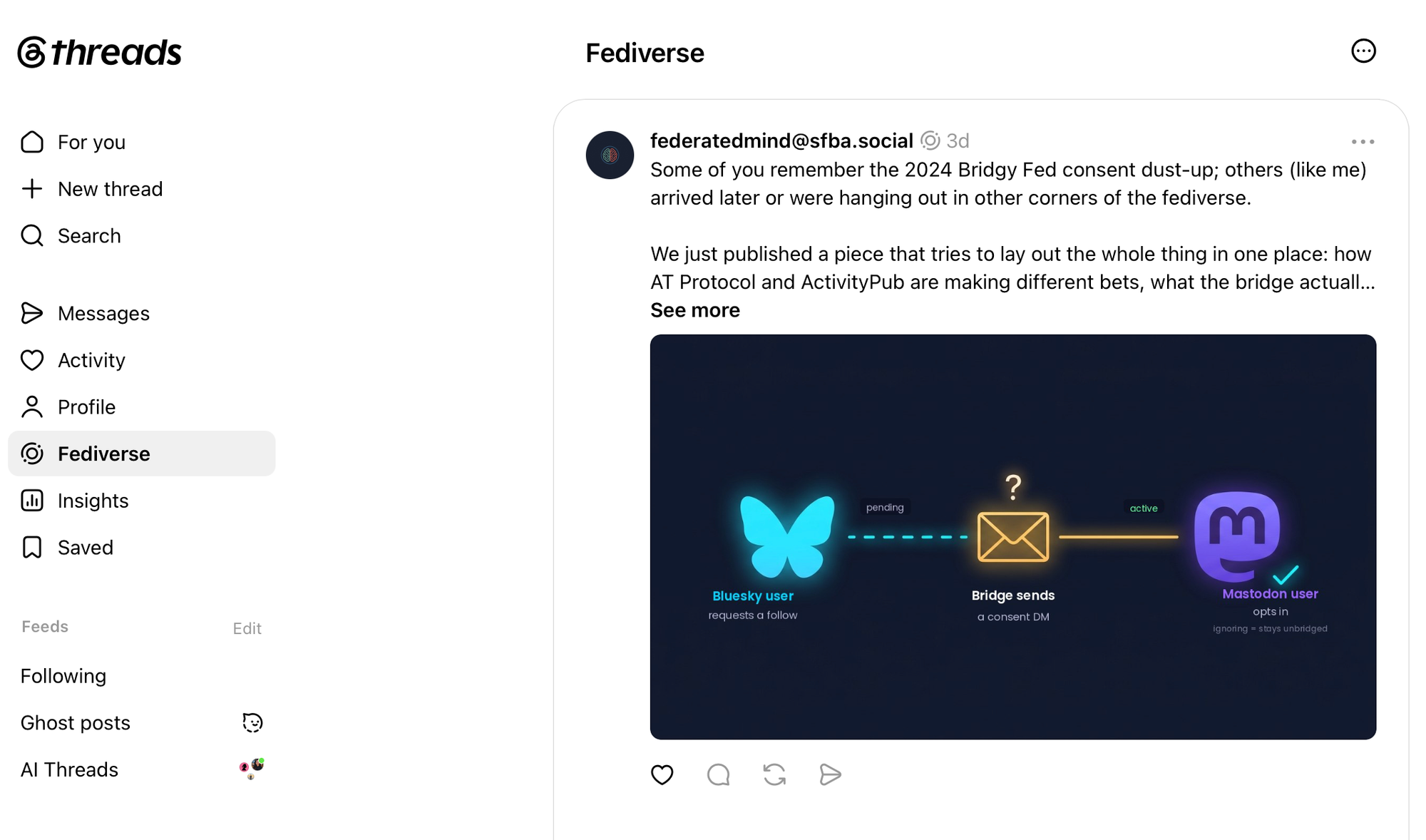
The accounts that opted in include some recognizable names. Marques Brownlee (MKBHD), whose YouTube channel has over 20 million subscribers, has over a million followers on Threads and is reachable from Mastodon at @mkbhd@threads.net. In April 2024, the Biden White House's @POTUS account enabled federation, making it the first presidential account on the fediverse, reachable at @potus@threads.net (no longer reachable as of 2026). The same protocol that connects a 500-person Mastodon instance connects a creator with millions of followers, or a sitting head of state. Most haven't opted in.
The adoption numbers reflect this friction. By January 17, 2025, approximately 25,900 Threads accounts had opted into federation out of a user base of 200 million, according to a February 2025 arxiv study from Arizona State University. Of those, only around 800 had actually followed at least one account on mastodon.social, per Fediverse Report #147. The feature existed. The behavior it was designed to enable mostly didn't. Those numbers show it.
What Meta collects
ActivityPub is a transparent protocol: any server that receives an interaction can see who sent it, what they sent, and where they came from. The protocol has no privacy mode that limits what a receiving server can see and store. That's a design property of the open web, not a quirk specific to Threads.
With Threads, the receiving server is Meta's. According to Meta's Supplemental Privacy Policy for Threads, the data that crosses includes actor identifiers, profile metadata, post content, and the interaction type. As with any web service, Meta's servers also see the IP address of any client that connects to them (a property of HTTP, not specific to ActivityPub, but worth noting given the scale). The policy's retention terms are worth reading directly before publishing a summary of them.
An 11-million-user fediverse interoperating with a 200-million-user platform gives Meta visibility not just into its own users' social graphs, but into the social graphs of people who chose a non-Meta platform. Fediverse users who interact with Threads content (who follow Threads accounts, like their posts, reply to them) generate data about their behavior and connections that flows to Meta's infrastructure regardless of which server they call home.
For communities that had migrated to the fediverse specifically to get off surveillance-backed platforms (LGBTQ+ users, activists, journalists on instances built to protect those groups), this wasn't an abstract concern. It was the exact structure they'd crossed a protocol boundary to leave behind.
The preemptive response
Over 700 instances had preemptively defederated from Threads before its public beta launched in March 2024. "Preemptive" is the operative word. These weren't admins responding to documented bad behavior from Threads — they were committing to defederate before any interaction had occurred, based on how they assessed Meta as an institution and what they predicted large-scale federation would mean for their users. (The mechanics of defederation and the Fedipact's origins are covered in depth in the Exploring Mastodon governance post.) The data collection structure described above was one part of that calculation, alongside concerns about corporate moderation values and the embrace-extend-extinguish pattern covered in the next section.
Mastodon.social, one of the largest general-purpose Mastodon instances, didn't sign. Eugen Rochko's reasoning: federation gives fediverse users more control, not less. Anyone who doesn't want Threads content in their feed can block at will; staying open to federation keeps the network reachable to users who might want it. Rochko applied this to the instance he runs, which serves hundreds of thousands of accounts. (Separately, in January 2026, he publicly opted his personal account out of the Bridgy Fed bridge to Bluesky, a reminder that his position isn't "all federation unconditionally," just that preemptive defederation from Threads was the wrong call for a general-purpose public instance.)
The 700-plus instances that signed reached the opposite conclusion. The Fedipact wasn't primarily a technical objection. It was a governance statement: that the risks of Meta's moderation values, surveillance infrastructure, and institutional behavior reaching their communities outweighed the value of being reachable by Threads users. The embrace-extend-extinguish concern (covered in the next section) was part of that calculus.
The EEE argument, honestly
Embrace, extend, extinguish is a Microsoft-era framework: adopt an open standard to gain adoption, extend it with proprietary features to create lock-in, then let the proprietary version crowd out the open one. Applied to Threads, the concern is that Meta could implement ActivityPub well enough to attract fediverse users, build recommendation infrastructure and product features that ActivityPub-native apps can't match, and gradually pull interaction toward Threads while nominally staying federated.
The counterargument has two parts. A distributed network is structurally harder to extinguish than a single competitor: there's no acquisition that closes it. And breaking federation would undermine the exact value proposition Meta used when announcing Threads' ActivityPub support.
The more precise version of the concern isn't extinguishment. It's norm-setting. A platform with Meta's engineering resources shapes what feels normal in ways ActivityPub-native platforms aren't resourced to keep pace with: recommendation algorithms, post format conventions, what counts as a reply worth seeing. The question isn't whether Meta "wins." It's whether a 200-million-user node with entirely different governance values, no community moderation structure, and no account portability roadmap eventually holds enough of the conversation that the fediverse's governance model becomes practically irrelevant to users who don't actively seek it out.
This is speculative, and the adoption numbers in 2025 don't tell you much about the future.
Where it landed
Two years into Threads federation, the bridge is real and almost nobody uses it.
Meta built what it said it would build. The protocol works, within the constraints the previous sections describe. The features shipped on a slower timeline than initially implied, stayed siloed rather than integrated into the main product, and then stopped moving. Account portability (the feature that would let a Threads user take their social graph to a different ActivityPub server) has no timeline and no announced roadmap.
The fediverse response was similarly inconclusive. Many instances defederated. Most didn't. Cross-network conversations mostly didn't happen: few accounts had opted in, the 15-minute delay made real-time exchange impractical, and the separate feed quietly discouraged anyone who might have stumbled into it casually. It doesn't help that Threads' own interface (especially in a browser) can be genuinely disorienting: multiple feeds, no clear hierarchy, features spread across tabs. The fediverse section sits somewhere in there.
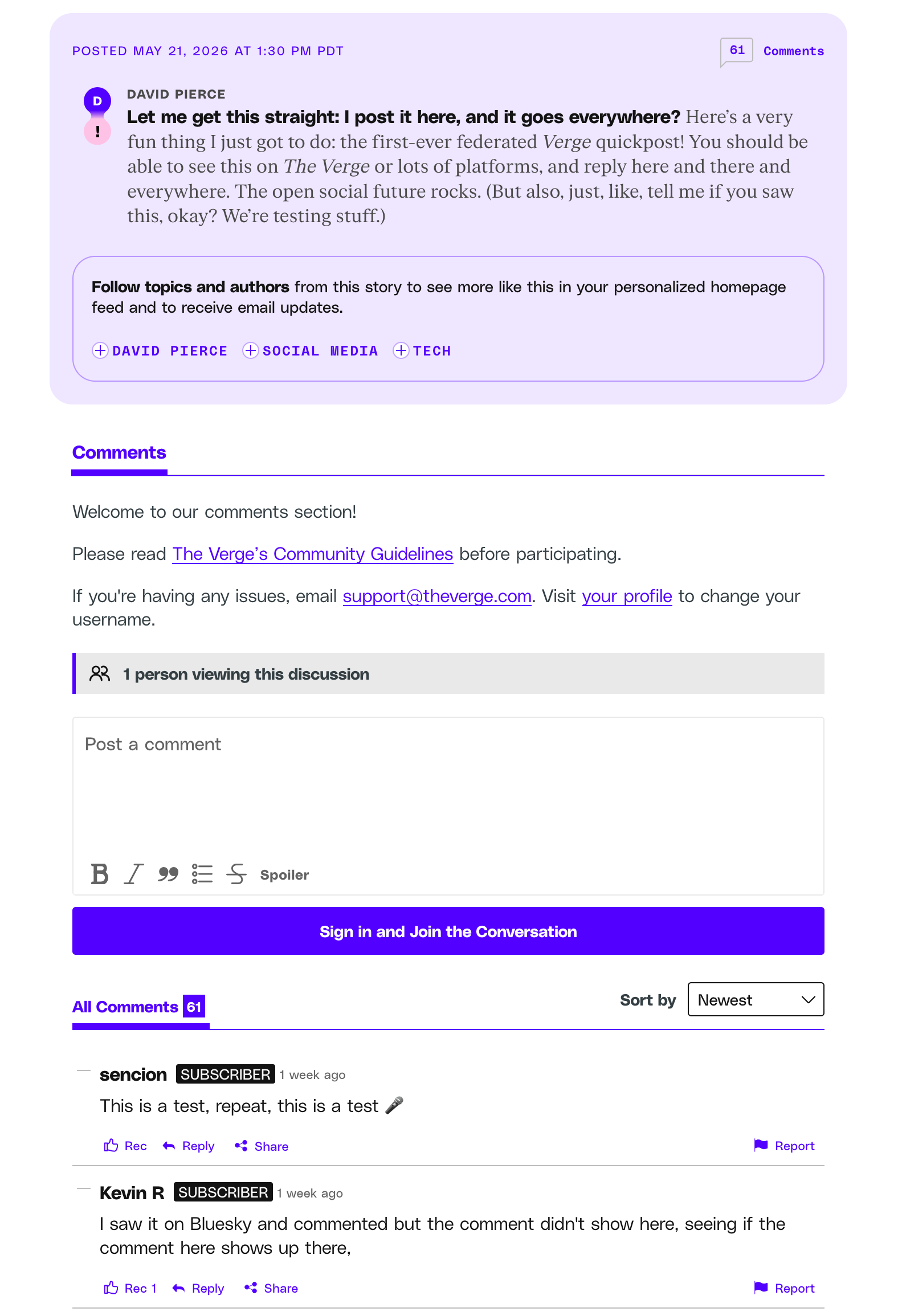
While Threads' own fediverse integration stalled, ActivityPub kept finding new uses. On May 21, 2026, David Pierce at The Verge posted what he described as the first-ever federated Verge quickpost: "Let me get this straight: I post it here, and it goes everywhere?" It did. The post appeared simultaneously in Mastodon feeds, the Threads Fediverse tab, and Bluesky; replies on each platform fed back as comments on the Verge article itself. Pierce's conclusion: "The open social future rocks." A media company was already using the same protocol as a publishing workflow.
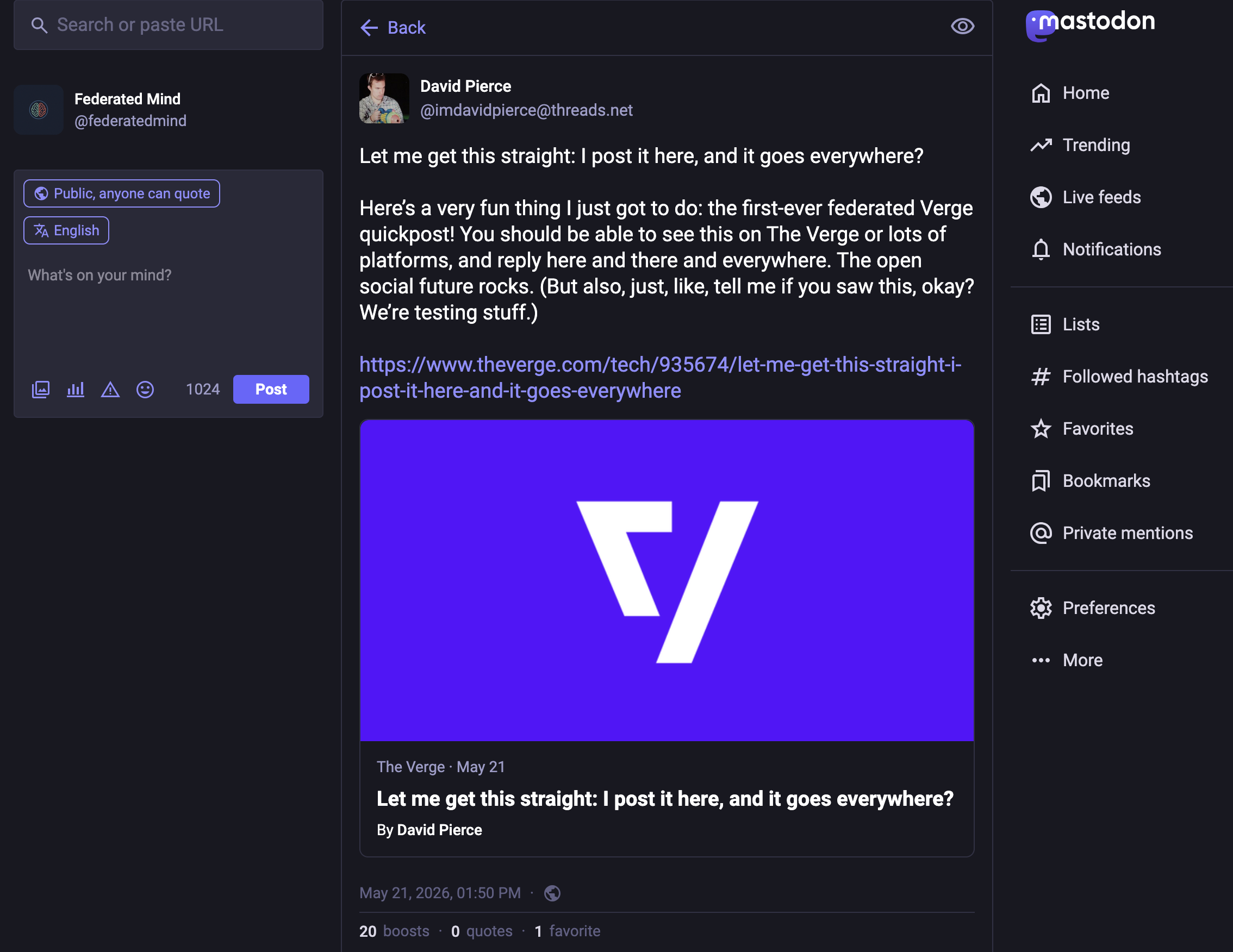
That handle also points to a less-obvious seam in Threads' implementation. When Meta moved its web interface to threads.com, fediverse handles stayed on threads.net, with no announced plans to change that. For most users it's invisible, but the web UI and the federation layer appear to be distinct systems. The domain split suggests as much, even if Meta hasn't formally documented the architecture.
Bridgy Fed, the primary bridge to Bluesky, was built by one person with a GitHub repository. The bridge to Threads was assembled by one of the largest engineering organizations in the world. Two years later, cross-network traffic on both remains modest. The bridges are built. The crossing is still optional.
The Exploring Mastodon ebook covers the governance layer in more depth: defederation, the Fedipact, and what fediverse governance means for creators choosing a server.
What's next in this series
The next post covers Nostr. Unlike Bluesky and Threads, Nostr doesn't try to bridge the fediverse. It ignores it. That's a design decision, not an oversight.
Sources and further reading
- Threads has entered the fediverse — Meta Engineering Blog, March 21, 2024
- Threads now lets users follow fediverse accounts — 9to5Mac, December 4, 2024
- Anti-Meta Fedipact
- How Threads will integrate with the fediverse — Tom Coates / plasticbag.org
- Threads adds fediverse post view, fediverse user search — Social Media Today
- Threads New Terms Affects the Fediverse — We Distribute
- Threads, The Fediverse, and the #FediPact — El Platt
- Meta Supplemental Privacy Policy (Threads fediverse section)
- FEP-e232: Object Links — SocialHub / ActivityPub Fediverse Enhancement Proposals
- Carnegie Endowment: Navigating Defederation on Decentralized Social Media
- Shadow .Net Domains: How Instagram, YouTube, Etcetera, Can "Easily" Enter The Fediverse — Darnell Clayton / darnell.tv
- Let me get this straight: I post it here, and it goes everywhere? — David Pierce / The Verge, May 21, 2026
- Fediverse Sharing: Cross-Platform Interaction Dynamics between Threads and Mastodon Users — arxiv, February 2025 (Arizona State University)
- Fediverse Report #147 — Connected Places
- It's Now Easier to See More Fediverse Content on Threads — Meta Newsroom, June 17, 2025
- @POTUS just joined the fediverse via Instagram Threads — TechCrunch, April 2, 2024
- Meta Platforms 2024 Annual Report — Headcount — Meta Platforms employee count, via Bullfincher
- An Exploration of the Twitter to Mastodon Migration — CUInfoScience / Medium
- Threads brings scale, Bluesky brings trust in social media's evolution — eMarketer
- Why publishers are preparing to federate their sites — Digiday
- The Case for the Fediverse — MacStories